The bone marrow microenvironment of RAS pathway mutant B-ALL is enriched for immunosuppressive regulatory T cells

The bone marrow microenvironment of RAS pathway mutant B-ALL is enriched for immunosuppressive regulatory T cells
Ferrao Blanco, M. N.; Kazybay, B.; Perzolli, A.; Kester, L.; Heidenreich, O.; Vormoor, H. J.
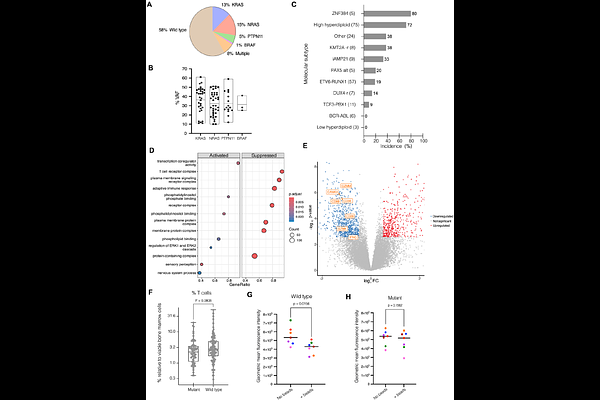
AbstractSomatic mutations in the RAS pathway are highly prevalent in B Cell Acute Lymphoblastic Leukemia (B ALL), yet their impact on the bone marrow immune microenvironment and response to immunotherapy remains poorly defined. In this study, we integrated bulk RNA sequencing, single cell RNA sequencing (scRNAseq), and spectral flow cytometry to characterize the immune landscape of RAS mutant B ALL. We identified pathogenic mutations in KRAS, NRAS, PTPN11, or BRAF in 42% of the cohort, predominantly as clonal events. Despite similar cell frequencies by flow cytometry, bulk transcriptomes from RAS mutant samples showed suppression of immune response and T cell activation pathways, and T cells from RAS mutant patients exhibited impaired proliferation ex vivo. Single cell analysis revealed higher CD8 dysfunction scores and enrichment of regulatory T cells (Tregs) in RAS mutant bone marrow. These findings were validated by spectral flow cytometry and by CIBERSORTx deconvolution of bulk data. Trajectory analysis supported a higher CD4 to Treg differentiation in the RAS mutant niche, and CellChat mapping identified contact dependent and checkpoint interactions (including TIGIT NECTIN2 and CTLA CD86/ICOSL) enriched in RAS mutant samples. Functionally, blinatumomab produced limited leukemic cell killing ex vivo overall, but addition of CTLA4 blockade (ipilimumab) selectively restored blinatumomab efficacy in RAS mutant samples. Together, these results indicate that RAS pathway activation associates with a Treg enriched, immunosuppressive bone marrow microenvironment and point to CTLA4 targeted strategies to enhance T cell engager efficacy in this subgroup.