A Cohort-Based Global Sensitivity Benchmark of MRI-Derived Whole-Heart Electromechanical Models in Healthy Hearts

A Cohort-Based Global Sensitivity Benchmark of MRI-Derived Whole-Heart Electromechanical Models in Healthy Hearts
Rahmani, S.; Pouliopoulos, J.; W. C. Lee, A.; Barrows, R. K.; Solis-Lemus, J. A.; Strocchi, M.; Rodero, C.; Qayyum, A.; Lashkarinia, S.; Roney, C.; Augustin, C. M.; Plank, G.; Fatkin, D.; Jabbour, A.; Niederer, S. A.
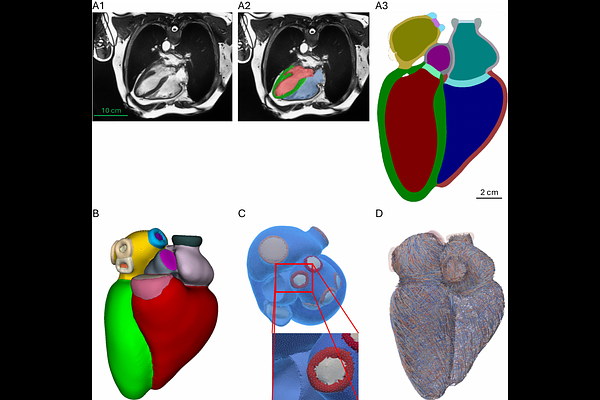
AbstractPatient-specific four-chamber electromechanical models provide a physics-constrained framework for investigating whole-heart cardiac physiology and disease mechanisms. Identifying which model parameters impact whole-heart function is important for understanding cellular-, tissue-, and organ-scale determinants of cardiac performance and for calibrating patient-specific models. However, previous global sensitivity analyses of cardiac electromechanical models have typically been performed on a single heart, and systematic evaluation of how parameter influence compares across anatomically different subjects remains limited.We created four-chamber electromechanical models using cardiac MRI from five healthy subjects (n = 5). The models simulated atrial and ventricular cellular electrophysiology, calcium dynamics, and active contraction, with heterogeneous fibre orientation, transversely isotropic tissue mechanics, pericardial constraint, and a closed-loop cardiovascular system providing physiological boundary conditions. In total, 46 parameters described the integrated model.Using Gaussian process emulators, we performed multi-scale global sensitivity analysis to evaluate the relative contribution of model parameters to left and right atrial and ventricular function. Across all anatomies, the most influential parameters were systemic and pulmonary resistances, ventricular end-diastolic pressures, and the venous reference pressure, highlighting the dominant role of haemodynamic loading conditions in governing pressure- and volume-based outputs.A chamber-level analysis of atrioventricular coupling revealed a phase-dependent pattern. Atrial pressures were predominantly governed by global haemodynamic parameters (>90% of total sensitivity), atrial filling volumes showed substantial ventricular influence ({approx}40-55% across anatomies), and atrial end-systolic volumes were primarily determined by intrinsic atrial parameters ({approx}60-65%). These patterns were consistent across subjects despite differences in anatomy.We show that, in healthy male subjects, inter-individual anatomical variation does not substantially change the ranking of dominant parameters. This work provides a repeatable modelling and sensitivity analysis framework and establishes a benchmark reference for whole-heart electromechanical modelling in healthy hearts.