The Dynamics of Long Terminal Repeat Proliferation in the Hesperis matronalis Genome

The Dynamics of Long Terminal Repeat Proliferation in the Hesperis matronalis Genome
Rifkin, J. L.; Johnson, S. E.; Weis, A. E.; Wright, S. L.; Baucom, R.
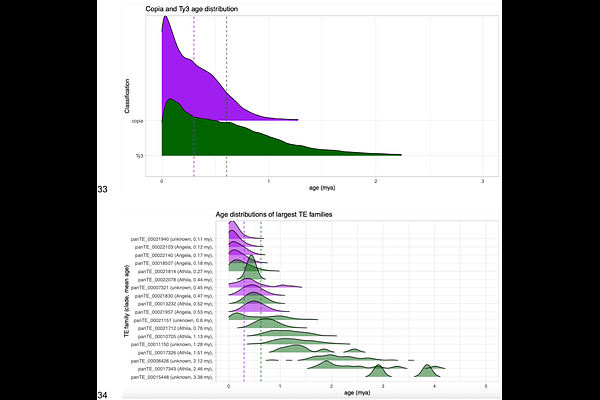
AbstractGenome sizes vary across four orders of magnitude in flowering plants, with consequences for evolution. Much of this variation is due to differences in transposable element content, particularly in long terminal repeat (LTR) retrotransposons. Despite their importance in plant genome evolution, LTRs have long been challenging to characterize because of their repetitive nature, but recent advances in sequencing allow more detailed explorations of their behavior. They are now known to occupy distinct genomic niches, and to evolve and proliferate over time as they escape host controls. In this study, we present a new genome sequence of the largest Brassicaceae genome, Hesperis matronalis, and describe its transposable element complement and how LTRs contributed to its genome expansion. We find evidence for both early proliferation of Ty3 elements and rapid recent expansion of Ty1-copia elements. In addition, we place the H. matronalis LTRs in a broader context of LTR evolution in the Brassicaceae, showing that the dominant copia families are part of an evolutionary radiation endemic to Hesperis. Finally, we describe differences in LTR age, proximity to genes, and apparent removal rate which suggest consistent genomic niches over the lifespan of a TE family. These results shed light on how LTRs evolve dynamically with host genomes, and have contributed to the expansion of the largest genome in the Brassicaceae.