Motile ciliophagy promotes ciliary recycling under stress

Motile ciliophagy promotes ciliary recycling under stress
Ren, M.; Melia, C.; Heesom, K.; Mali, G. R.
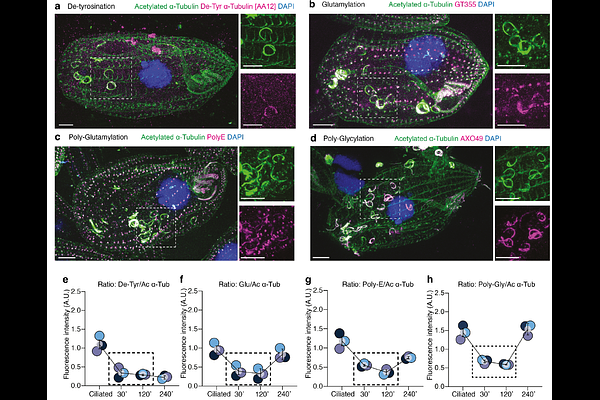
AbstractMotile cilia on eukaryotic cell surfaces are exposed to a wide array of external stresses. Ciliary remodeling in response to stress remains understudied despite being pivotal to cell homeostasis. Here, we apply a commonly used calcium perturbation to mimic hyper-osmotic cellular stress in the model ciliate Tetrahymena thermophila. We find that partially deciliated Tetrahymena, upon calcium shock, internalise entire ciliary axonemes into ring-like configurations we refer to as c-rings. Partially deciliated cells recover and regenerate new cilia over time. We propose that the recycling of c-rings releases axonemal building blocks to allow ciliary regeneration. We use time-course ultrastructure expansion microscopy (U-ExM) to show that the ciliary tubulin code undergoes a dynamic pattern of erasure during the bulk disassembly of doublet microtubules within the c-rings. Using whole cell quantitative proteomics, we find that partial deciliation induces the autophagy of c-rings and activates de novo dynein synthesis by upregulating several axonemal dynein assembly factors (DNAAFs). Transmission electron microscopy (TEM) and confocal imaging confirms that intact ciliary axonemes are encapsulated within VPS13A +ve autophagic vacuoles. We propose that internalised motile cilia undergo a regulated process of bulk degradation we term motile ciliophagy for the recycling of axonemal components for cilia regeneration. Our work establishes a link between ciliary turnover via macroautophagy and cellular homeostasis which may be a conserved response to stress.