ST-PARM: Pareto-Complete Inference-Time Alignment for Multi-Objective Protein Design

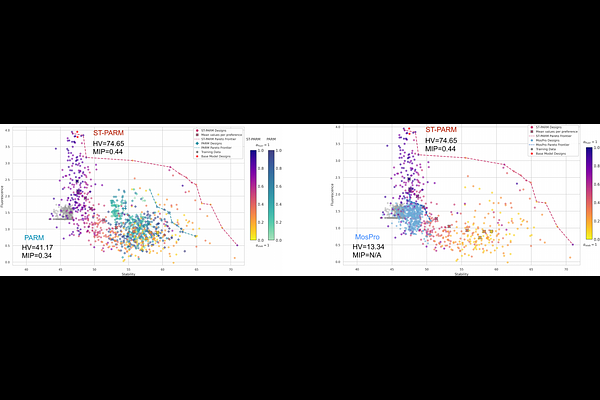
ST-PARM: Pareto-Complete Inference-Time Alignment for Multi-Objective Protein Design
Yin, R.; Shen, Y.
AbstractMotivation: Protein engineering is inherently multi-objective: improving one property can degrade others, so practical workflows require generating non-dominated (Pareto-optimal) candidates spanning a trade-off surface. Linear objective scalarization and deterministic pairwise preference learning can under-explore non-convex Pareto regions and amplify noise from uncertain evaluators, limiting Pareto coverage and trade-off controllability. Results: We introduce Smooth Tchebycheff Preference-Aware Reward Model (ST-PARM), an inference-time alignment framework that steers a frozen protein language model along user-specified trade-offs with a lightweight reward model trained only once. ST-PARM combines (i) a reward-calibrated pairwise preference loss that is uncertainty-aware by down-weighting ambiguous comparisons under noises, (ii) a smooth Tchebycheff scalarization that is Pareto-complete in principle and improves empirical trade-off coverage, and (iii) latent-space pair-construction strategies. On GFP fluorescence--stability (full-length design) and IL-6 nanobody stability--solubility (CDR3+suffix design), ST-PARM delivers broader Pareto coverage and stronger preference tracking than baselines PARM and MosPro. For GFP, a conservative structural screen for local confidence and global fold preservation retains a broad frontier and strong controllability, yielding an actionable cohort for downstream assays. We also provide cross-evaluator robustness checks, a three-objective extension, and a natural-language alignment generality check in the Supplement, establishing a practical foundation for controllable sequence generation under competing multi-objectives and noisy measurements. Availability and Implementation: https://github.com/Shen-Lab/ST-PARM.