A Composite Endomembrane Suspension Governs Cytoplasm Rheology

A Composite Endomembrane Suspension Governs Cytoplasm Rheology
Arjona, M. I.; khosravanizadeh, A.; Municio-Diaz, C.; Mioche, M.; Dmitrieff, S.; Salle, J.; Marteil, A.; Durieu, C.; Pontani, L. L.; Wandersman, E.; MINC, N.
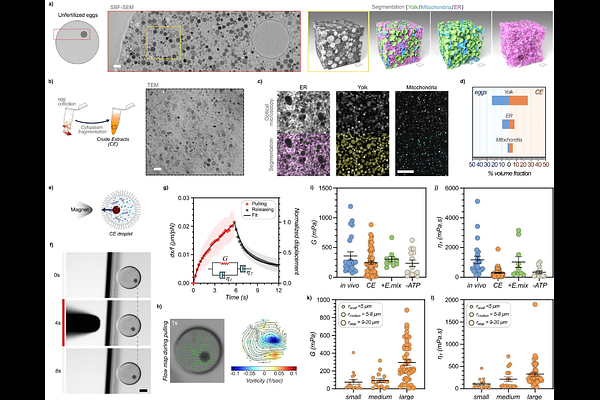
AbstractThe cytoplasm of eukaryotic cells is populated by dense disordered suspensions of filamentous and granular endomembranes, yet how they contribute to the mechanical behavior of the cell interior remains unknown. We combined active micro-rheology, cell-like encapsulation and simulations to study the material properties of marine egg extract fractions enriched in distinct endomembrane components. We characterized the cytoplasm as a composite suspension made of yolk granules interspaced by sheets and tubules of endoplasmic reticulum (ER) bathed in cytosolic fluid, that occupies ~38% of cell volume. Remarkably, while isolated cytosol, yolk or ER fractions had characteristics of Newtonian fluids, their combination yielded the emergence of viscoelasticity and glass-like dynamics closely resembling that of in vivo cytoplasm. Our data suggest that the ER acts as a sterically excluding backbone that drives the formation of load-bearing yolk flocculation structures to endow the cytoplasm with solid-like properties at volume fractions far below random close packing. This work establishes a generic framework to understand the material properties of composite endomembrane suspensions, and delineates a novel strategy by which eukaryotic cells may tune the physical state of their cytoplasm.