Host community activity, but not always composition, explains viral biogeography in bulk and rhizosphere soils over a tomato growing season

Host community activity, but not always composition, explains viral biogeography in bulk and rhizosphere soils over a tomato growing season
Stern, L.; ter Horst, A. M.; Simpson-Johnson, K. E.; Gaudin, A. C. M.; Emerson, J. B.
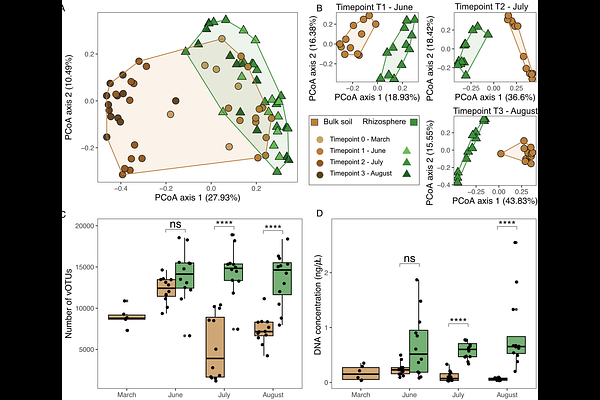
AbstractThe soil microbiome is key to plant health and nutrient acquisition, and viruses likely play important but largely unknown roles in these processes. To interrogate bulk and rhizosphere soil viral biogeography, we collected samples over a tomato growing season in California from an experiment testing arbuscular mycorrhizal fungi (AMF) treatment. We generated 78 viromes, 16S rRNA gene, and ITS1 amplicon datasets, and 33 rhizosphere metatranscriptomes. Of 67,038 DNA viral 'species' genomes (vOTUs), 25% were previously identified, predominantely in agricultural systems, suggesting habitat filtering and greater viral homogeneity across agricultural compared to natural soils globally. Rhizospheres had significantly higher DNA viral richness than bulk soils, whereas no significant richness differences were observed for other biota. 60% of vOTUs were shared between compartments, compared to only 21-23% of bacterial and fungal taxa. Although bulk soil viral biogeography resembled that of prokaryotes, with significant structuring by moisture content, greater virome similarity between high-moisture bulk soils and rhizospheres suggests that conditions with high host activity selected for similar viral communities. In rhizospheres, while bacterial and fungal communities differed most over time, DNA and RNA viral communities differed most by sampling location, matching prokaryotic transcriptional patterns and further implicating host activity in viral biogeography. Similarly, AMF treatment induced changes in the prokaryotic transcriptome but, across biota, only significantly affected DNA viral communities. Overall, results indicate strong viral responses to spatiotemporally localized conditions, with viral biogeography reflecting both dispersal opportunities (high between neighboring bulk and rhizosphere soils, low across fields) and selection via local host activity.