Large-scale endoplasmic reticulum membrane solidification spatially organizes proteins under thermal or metabolic stress

Large-scale endoplasmic reticulum membrane solidification spatially organizes proteins under thermal or metabolic stress
Mueller, P. M.; Mikolaj, M. R.; Belbaraka, E.; Hartstein, F.; Altinoluk, S.; Perder, B.; Trnka, P.; Welke, R.-W.; Naumann, H.; Taudien, N.; Solimena, M.; Kunz, S.; Levental, I.; Levental, K. R.; Mueller, A.; Ewers, H.; Narayan, K.; Rocks, O.
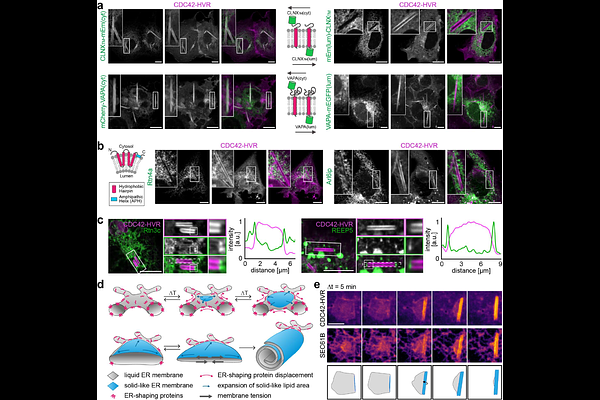
AbstractOrganelle homeostasis is a key determinant of cellular fitness, yet how cells remodel their membranes in response to environmental change remains unclear. Here, we identify a temperature- and lipid saturation-dependent transformation of endoplasmic reticulum membranes into giant, rigid, multilamellar tubes in cells and in vivo. These "rods" emerge from demixing of saturated lipids into solid-like domains - a previously unrecognised, large-scale endomembrane phase behaviour, fundamentally distinct from the transient liquid-ordered nanodomains of the plasma membrane. ER-tubulating reticulon-homology proteins are excluded from rods; their segregation drives progressive membrane flattening and ultimately multilayered wrapping. Surfactant-producing alveolar type-II lung cells, enriched in saturated lipids, form rods even at 37degC, demonstrating that native lipid metabolism can induce this transformation. This spatially organizing lipid-protein domain interplay may tune the ER tubule/sheet balance and provide a homeoviscous mechanism to preserve fluidity in the cholesterol-poor ER under thermal or metabolic stress.