Beyond the Classical Ceiling: Multi-Layer Fully-Connected Variational Quantum Circuits

Beyond the Classical Ceiling: Multi-Layer Fully-Connected Variational Quantum Circuits
Howard Su, Chen-Yu Liu, Samuel Yen-Chi Chen, Kuan-Cheng Chen, Huan-Hsin Tseng
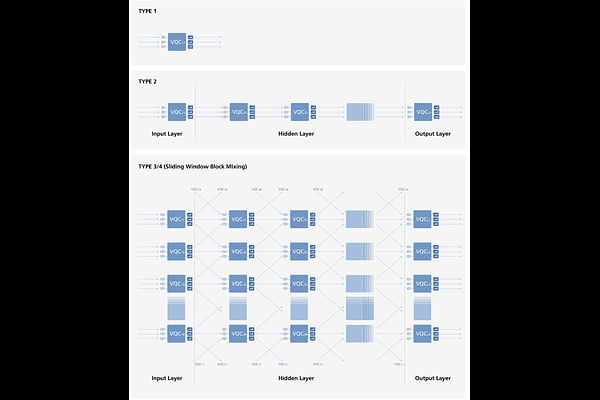
AbstractStandard Variational Quantum Circuits (VQCs) struggle to scale to high-dimensional data due to the ``curse of dimensionality,'' which manifests as exponential simulation costs ($\mathcal{O}(2^d)$) and untrainable Barren Plateaus. Existing solutions often bypass this by relying on classical neural networks for feature compression, obscuring the true quantum capability. In this work, we propose the \textbf{Multi-Layer Fully-Connected VQC (FC-VQC)}, a modular architecture that performs \textbf{end-to-end quantum learning} without trainable classical encoders. By restricting local Hilbert space dimensions while enabling global feature interaction via structured block mixing, our framework achieves \textbf{linear scalability $\mathcal{O}(d)$}. We empirically validate this approach on standard benchmarks and a high-dimensional industrial task: \textbf{300-asset Option Portfolio Pricing}. In this regime, the FC-VQC breaks the ``Classical Ceiling,'' outperforming state-of-the-art Gradient Boosting baselines (XGBoost/CatBoost) while exhibiting \textbf{$\approx 17\times$ greater parameter efficiency} than Deep Neural Networks. These results provide concrete evidence that pure, modular quantum architectures can effectively learn industrial-scale feature spaces that are intractable for monolithic ansatzes.