Black-Hole mimickers in GR and $f(R)$ gravity

Black-Hole mimickers in GR and $f(R)$ gravity
Hodek M. García, Marcelo Salgado
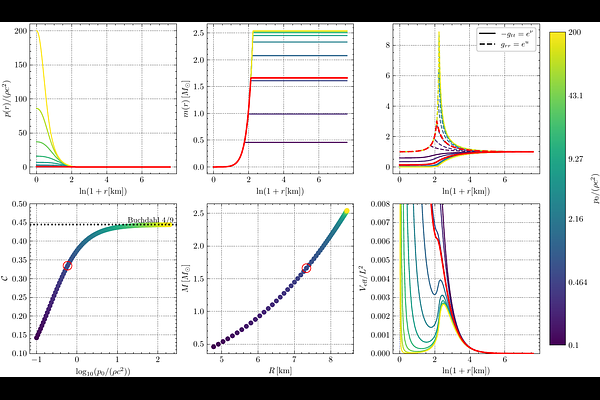
AbstractBlack hole mimickers (BHMs) are horizonless globally regular ultracompact relativistic self-gravitating objects (UCOs) of mass $M$ and radius $R$ with compactness $C = M/R$ higher than that of a neutron star and that produce an effective potential for null geodesics (photons) that possesses a local maximum, which is usually accompanied by an inner local minimum. The presence of a local maximum allows for unstable circular orbits to exist similar to light rings present in actual BH solutions, while it has been conjectured that the presence of a local minimum is symptomatic of potential instabilities. One such candidate for a BHM is a solitonic boson star (SBS) which is a boson star endowed with a sextic potential. In this paper we investigate further solutions of static and spherically symmetric SBSs in general relativity with a larger set of parameter values, and argue that such solutions are very similar to UCOs composed of an incompressible perfect fluid (IPF) with a sufficiently large pressure (the mimicker of a BHM). These IPFUCOs reach the Buchdahl limit $C= 4/9$ for arbitrarily large pressures. We investigate the extent to which the IPFUCOs constructed within a quadratic model in $f(R)$ gravity can overcome this limit or not, and thus pave the way for possibly building SBSs (or other kind of UCO) within this (or other alternative theory of gravity). We further elaborate about the stability properties of SBSs which have been the subject of some controversy recently.