Ultrafast X-Rays Capture Retinal Traversing Conical Intersection in Rhodopsin

Ultrafast X-Rays Capture Retinal Traversing Conical Intersection in Rhodopsin
Grant, T. D.; Perera, S. M. D. C.; Salas-Estrada, L. A.; Menon, C. S. K.; Struts, A. V.; Xu, X.; Fried, S. D. E.; Weerasinghe, N.; Chawla, U.; Alvarez, R.; Hu, H.; Karpos, K.; Lisova, S.; Nazari, R.; Zaare, S.; Coe, J.; Fromme, R.; Meza, D.; Singharoy, A.; Chamberlain, S. R.; Moore, S.; Zatsepin, N. A.; Perakis, F.; Carbajo, S.; Hunter, M. S.; Liang, M.; Seaberg, M. D.; Boutet, S.; Mendez, D.; Grossfield, A.; Fromme, P.; Kirian, R. A.; Brown, M. F.
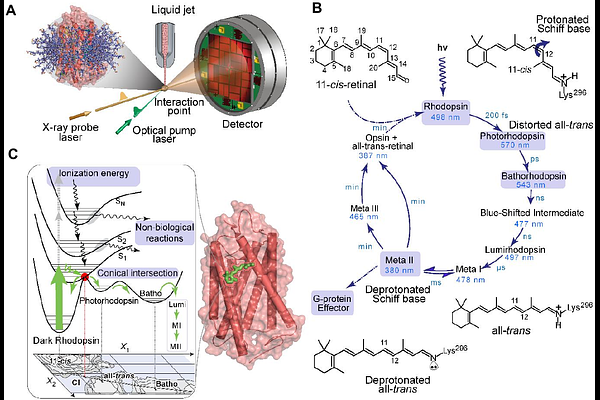
AbstractG-protein-coupled receptors of the Rhodopsin family are crucial medicinal targets, transmitting signals across biomembranes. While light absorption by visual rhodopsin is well studied, its activation via retinal cofactor dynamics remains unclear. Here we use a free-electron laser to show that time-resolved X-ray solution scattering captures the retinal cis-trans isomerization as it passes the conical intersection of excited and ground-state photoproduct energy surfaces. Femtosecond-scale nuclear changes occur due to resonant photon absorption, with all-atom simulations revealing ultrafast amino acid movements that initiate transmembrane helix shifts. Ligand-free opsin measurements confirm that light activation is unaffected by non-resonant processes, showing the photonic energy is directly transmitted within the protein. Our method unveils how cofactor dynamics activate rhodopsin, free of constraints from crystal lattice packing or cryotrapping photointermediates.