SN 2023iop: An Extreme 1987A-like Supernova and the Death of Very Massive Stars

SN 2023iop: An Extreme 1987A-like Supernova and the Death of Very Massive Stars
Steve Schulze, Avinash Singh, Nikhil Sarin, Ofer Yaron, Jesper Sollerman, Takashi J. Moriya, Avishay Gal-Yam, Bart van Baal, Stan Barmentloo, Conor M. B. Omand, Hannah Wichern, Tuomas Kangas, Priscila J. Pessi, Adam A. Miller, Armin Rest, Lin Yan, Alexei V. Filippenko, Chang Liu, Miika Pursiainen, Yi Yang, Georgios Dimitriadis, Kishalay De, Seán J. Brennan, Thomas G. Brink, Ping Chen, Aleksandar Cikota, Felice Cusano, Nicholas Earley, Claes Fransson, Lluís Galbany, Anamaria Gkini, Anders Jerkstrand, Ragnhild Lunnan, Keiichi Maeda, Diego Paris, Andrea Rossi, Nabeel Rehemtulla, Claudia Skoglund, WeiKang Zheng, Alaa Alburai, Ke-Jung Chen, K-Ryan Hinds, Anjasha Gangopadhyay, Jonay Isaí Gonzalez-Hernandez, Assaf Horesh, Giorgos Leloudas, Eliana Palazzi, Daniel A. Perley, Frédérick Poidevin, Ramon Sanfeliu, Jacob L. Wise, Erez A. Zimmerman, Alice Cai, Joahan Jaimes, Ting-Wan Chen, Michael W. Coughlin, Richard Dekany, Ori D. Fox, Christoffer Fremling, Matthew J. Graham, Steven Groom, Mansi M. Kasliwal, Marek Kowalski, Russ E. Laher, Paraskevas Lampropoulos, Elisabetta Maiorano, Ester Marini, Jakob Nordin, Josiah Purdum, Reed Riddle, Niharika Sravan, Aswin Suresh
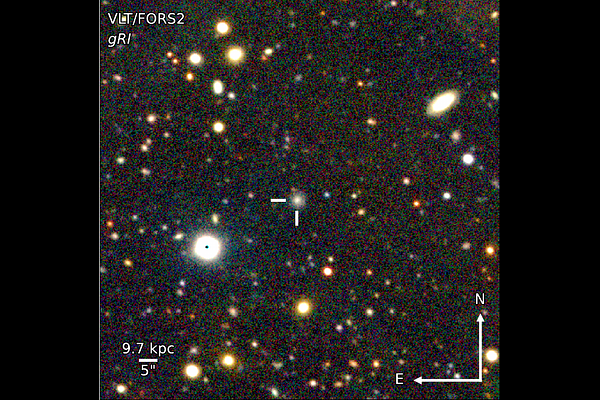
AbstractSupernova (SN) 1987A showed that some hydrogen-rich core-collapse supernovae (SNe) rise slowly to peak, defining a distinct subclass. Wide-field surveys have uncovered more extreme members, such as OGLE-2014-SN-73, SN 2020faa, and SN 2023vbw, that challenge neutrino-driven explosion models. We present ultraviolet-to-infrared, radio, X-ray, and spectropolarimetric observations of SN 2023iop at $z = 0.1020$, the most extreme 87A-like event to date. It rose for $\gtrsim88$ rest-frame days to $M_r \approx -20.1$ mag, also placing it among the hydrogen-rich superluminous SNe, and radiated $\gtrsim4\times10^{50}$ erg. Its spectra resemble those of typical Type II SNe and remain photospheric at $\sim330$ days post-maximum. Continuum polarization of 0.8-1.0% indicates an aspherical system. Hydrogen-rich pair-instability supernova (PISN) models of a $190~M_\odot$ star reproduce the light-curve up to 150 days after peak, but not the late-time emission. A late-time spectrum shows a feature near 7300 Å, tentatively identified as [Ni II] $λ$7378. The implied $\approx0.02~M_\odot$ of stable $^{58}$Ni is reached only in the most massive PISN models. The low-mass host galaxy ($\sim10^{8.2}~M_\odot$) is consistent with a metal-poor progenitor as required by the PISN channel. Fallback accretion reproduces the light-curve morphology, but not the colors. We consider a pair-instability explosion the most plausible scenario, with the late-time light-curve excess powered by circumstellar interaction, which shows no signatures in the spectra. SN 2023iop shows that the most luminous 87A-like events occupy an underexplored region of massive-star evolution.