Unveiling axion signals in galactic supernovae with future MeV telescopes

Unveiling axion signals in galactic supernovae with future MeV telescopes
Zhen Xie, Jiahao Liu, Bing Liu, Ruizhi Yang
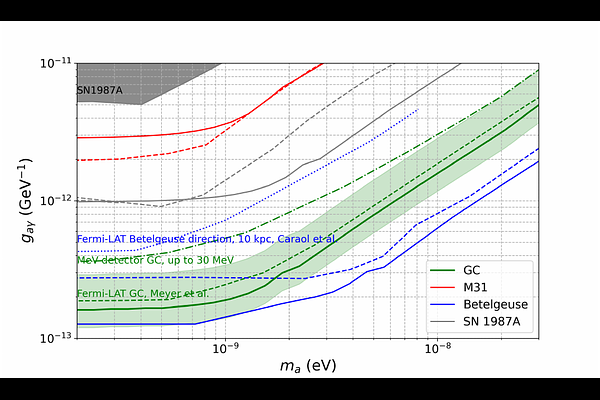
AbstractAxion-like particles (ALPs) produced via the Primakoff process in the cores of Galactic core-collapse supernovae (SNe) could convert into MeV-energy gamma-rays through interactions with the Milky Way's magnetic field. To evaluate the detection prospects for such signals, we perform sensitivity projections for next-generation MeV telescopes by combining hypothetical instrument responses with realistic background estimates. Our analysis incorporates detailed simulations of the expected ALP flux from nearby SNe, the energy-dependent conversion probability in Galactic magnetic fields, and the telescope's angular/energy resolution based on advanced detector designs. Background components are modeled using data from current MeV missions and extrapolated to future sensitivity regimes. Our simulations demonstrate that next-generation telescopes with improved effective areas and energy resolution could achieve sensitivity to photon-ALP couplings as low as gagamma approx 1.61 x 10^-13 GeV^-1 for ALP masses ma < 10^-9 eV in Galactic Center. These results indicate that future MeV missions will probe unexplored regions of ALP parameter space, with conservative estimates suggesting they could constrain gagamma values two orders of magnitude below current astrophysical limits. Such observations would provide the most stringent tests to date for axion-like particles as a dark matter candidate in the ultra-light mass regime.