A general estimation framework for continuous-variable systems

A general estimation framework for continuous-variable systems
Luca Innocenti, Simone Artini, Diana A. Chisholm, Salvatore Lorenzo, Alessandro Ferraro, G. Massimo Palma, Mauro Paternostro, Gabriele Lo Monaco
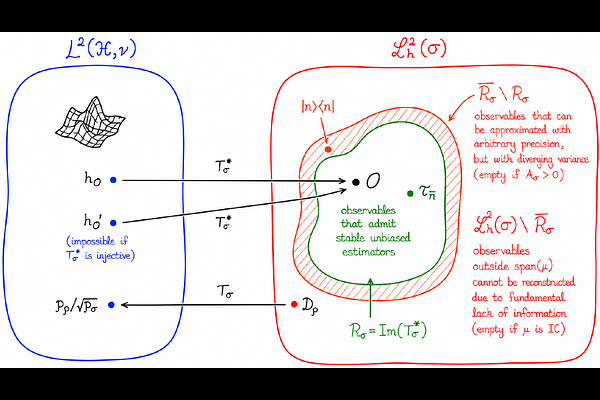
AbstractWe show that informational completeness, while sufficient to have a bijection between ideal measurement probabilities and quantum states, does not guarantee statistically stable reconstruction from finite measurement data. To address this problem, we develop a general estimation theory for continuous-variable systems in which stable reconstructibility is characterized by the POVM effects forming a measurement frame. Informational completeness is therefore necessary, but not sufficient, for stable reconstruction. Our framework is based on measurement frames in a $σ$-regularized operator geometry, where the reference state $σ$ encodes prior information about relevant features of the measured states. For any fixed measurement scheme, observables may be inaccessible, weakly reconstructible only through estimators with divergent variance, or stably reconstructible by finite-variance unbiased estimators. The relevant regime is determined by the range of the POVM synthesis operator. Our framework provides practical methods for constructing estimators and gives an operational interpretation of singular quasiprobability distributions, including the Glauber-Sudarshan $P$ representation: quasiprobabilities act as unbiased estimators for associated observables, and their singularities reflect a pathological feature of the corresponding measurement: its lack of loewr frame bound. We furthermore show how this formalism naturally provides operational regularization procedures tied to prior information. Overall, our framework provides a unified view of continuous-variable tomography, quasiprobability representations, and classical-shadow estimation.