Insights into mechanisms of ATM activation via constitutively active mutants

Insights into mechanisms of ATM activation via constitutively active mutants
Islam, M. S.; Gautsch, V. G.; Belotserkovskaya, R.; Serrano-Benitez, A.; Buzafalvi, D.; Perisic, O.; Jackson, S. P.; Williams, R. L.
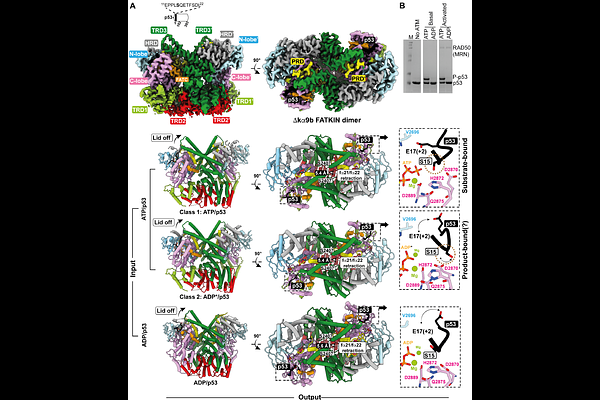
AbstractThe Ser/Thr kinase ATM orchestrates cellular responses to DNA double-strand breaks (DSBs) and promotes DSB repair by homologous recombination. In this process, ATM is activated by DNA and the MRN (MRE11, RAD50, and NBS1) complex. Here we show that mutations of the conserved PIKK regulatory domain (PRD) within ATM's kinase domain can confer a maximally active state that no longer requires MRN/DNA. In ATM-knockout human cells, the PRD mutants display substantially higher phosphorylation of histone H2AX, KAP1, and CHK2 than wild-type, with or without IR-induced DNA damage. Cryo-EM structures of two PRD mutants each revealed basal or activated conformations depending on bound ligands, suggesting that eliminating the ordered portion of the PRD results in an enzyme poised to transition to the active conformation. However, the identity of the active-site nucleotide is a key driver of the conformational switching. We speculate that this plasticity might be exploited to develop small-molecule ATM modulators for therapeutic applications.