Black hole Limits Redefined: Extreme Efficiency in Black Hole Jets

Black hole Limits Redefined: Extreme Efficiency in Black Hole Jets
Antonios Nathanail
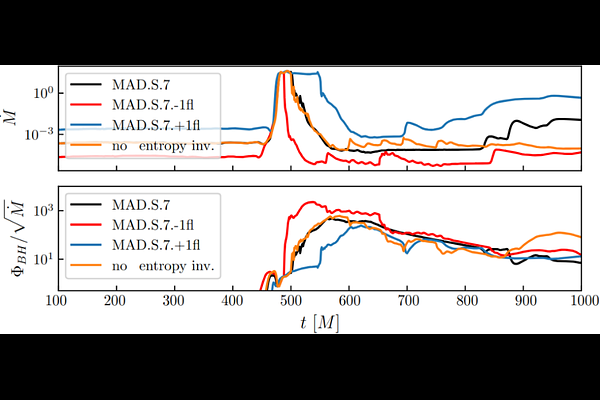
AbstractRelativistic jets from black holes can extract energy not only from accretion but also directly from the black hole's spin, as described by the Blandford-Znajek mechanism. A longstanding question is whether magnetic flux can accumulate near the event horizon to such an extent that it halts accretion entirely, enabling energy extraction purely from spin. Previous studies have shown that accretion persists through instabilities and that jet power only modestly exceeds the accretion energy budget, yet some observational results suggest much higher efficiencies. Here we present state-of-the-art general relativistic magnetohydrodynamic (GRMHD) simulations that sustain a quasi-steady magnetically arrested disk state for approximately 10,000 dynamical times, during which accretion is globally suppressed across the full azimuthal extent. In this regime, jet power exceeds the accretion energy input by more than two orders of magnitude, demonstrating a previously unachieved level of efficiency. These results challenge conventional assumptions about the limits of black hole energy extraction and suggest a new framework for interpreting powerful jet systems. Our findings raise important questions about the long-term stability of such states and the fundamental limits of the Blandford-Znajek process.