Structure and genomic organization of the human DUX4 homologue bovine DUXC

Structure and genomic organization of the human DUX4 homologue bovine DUXC
Yasar, B.; Org, T.; Ivask, M.; Yazgeldi Gunaydin, G.; Boskovic, N.; Jaakma, U.; Kere, J.; Kurg, A.; Katayama, S.
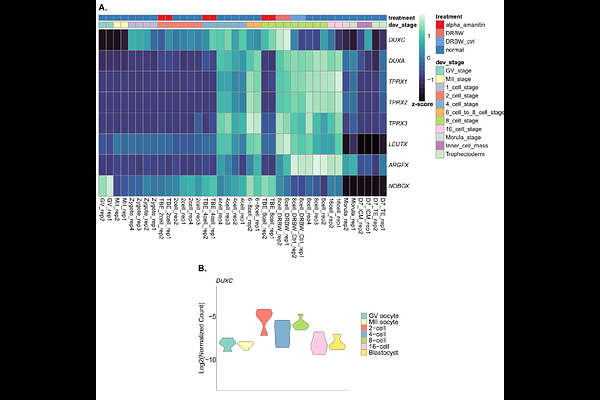
AbstractBackground: DUXC is a multi-copy transcription factor gene found within a long tandem repeat locus in several Laurasiatherians. It is suggested to be functionally similar to human DUX4 because of its shared C-terminal domain and its close phylogenetic relationship to DUX4. DUX family genes are transiently expressed in preimplantation embryos of placental mammals. However, early embryo-derived cDNA proof for DUXC, which is needed for its further functional characterization, has not been reported so far. Results: Our study provides a full-length sequence of DUXC mRNA, derived from the 8-cell stage in vitro fertilization (IVF) bovine embryos, containing double homeobox and 9aa transactivation domain (9aaTAD)-encoding sequences. Identified DUXC sequence uncovered a first exon that was not previously annotated. We showed that DUXC mRNA levels are independent of the embryonic transcription at the 2-, 4-, and 8-cell stage, whereas its decline, observed from the 8-cell stage onwards, is minor embryonic genome activation (EGA)-dependent. We also investigated the genomic organisation of the DUXC array in eight different cattle breed assemblies, revealing polymorphic internal repeats flanked by an incomplete distal unit at the telomeric end and a much shorter unit at the proximal end of the DUXC array. Despite the presence of a putative polyadenylation signal downstream the distal unit, we presented evidence for the expression of internal but not distal DUXC in early bovine IVF embryos. Conclusions: DUXC is a potential bovine EGA inducer, supported by its expression at peak levels at pre-EGA stages followed by a decrease with a dependency on minor EGA.