Nuclear blebs are composed of variable chromatin states but consistently enrich transcription initiation relative to elongation

Nuclear blebs are composed of variable chromatin states but consistently enrich transcription initiation relative to elongation
Clark, M. E.; Losada, A.; Jahng, S. E.; Saini, A.; Chowhan, F. A.; Woods, G. L.; Cutler, A. S.; Hallerman, S. A.; Gayed, M. A.; Bhalerao, S. R.; Bullock, E.; Santry, C. S.; Panagiotou, A. G.; Lapolla, B.; Bhatta, N.; Freidus, S. J.; Kaur, G.; Bai, D.; Hu, D.; Tadbiri, K.; Packard, M.; Dorfman, K.; Borowski, N.; Prince, K.; Lang, N.; Fermino do Rosario, C.; Stephens, A. D.
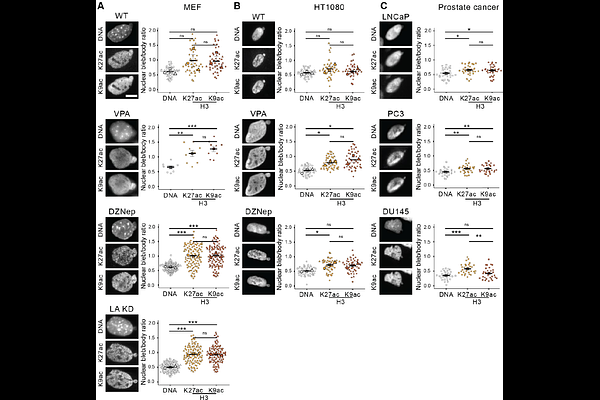
AbstractNuclear blebs are herniations of the nucleus that occur in many human conditions including aging, heart disease, muscular dystrophy, and many cancers. Nuclear blebbing causes nuclear rupture and cellular dysfunction. However, understanding the formation, stability, and identification of nuclear blebs remains an ongoing challenge. Our previous studies reveal that nuclear blebs are best hallmarked by decreased DNA density. To determine if chromatin decompaction underlies decreased DNA density in nuclear blebs, we investigated the histone composition of nuclear blebs across multiple cell lines. Time lapse and immunofluorescence imaging revealed that global histone H2B and H3 levels are decreased in the nuclear bleb relative to the nuclear body. Next, we imaged histone modification states of euchromatin and heterochromatin, which respectively track decompact and compact states of chromatin. Overall, we find that nuclear blebs display variable histone modification state across cell lines, as euchromatin does not consistently enrich nor is heterochromatin consistently depleted. Nuclear blebs did consistently show active RNA Pol II initiation is enriched relative to elongation. Thus, we find that the local histone modification state is not an essential component of nuclear blebs while transcription initiation enrichment over elongation is reproducible across cell lines and conditions.