Multi-Omics Characterization of Plasma and Urine Extracellular Vesicles Identifies Non-Invasive Biomarkers for IgA Nephropathy

Multi-Omics Characterization of Plasma and Urine Extracellular Vesicles Identifies Non-Invasive Biomarkers for IgA Nephropathy
Lin, Y.-H.; Chang, T.; Tsai, I.-L.; Parati, J.; Kao, C.-C.
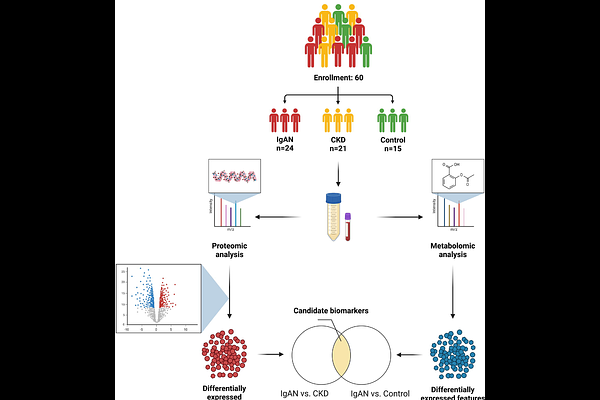
AbstractAbstract Background IgA nephropathy (IgAN) is increasingly recognized as a systemic immune-mediated disease characterized by aberrant IgA1 glycosylation, circulating immune complex formation, complement activation, and emerging metabolic perturbations. However, clinical diagnosis still relies on invasive renal biopsy, and non-invasive biomarkers capable of capturing both systemic immune activation and kidney-specific alterations remain lacking. Extracellular vesicles (EVs), as biologically active carriers of proteins and metabolites, provide a unique opportunity to interrogate compartment-specific molecular signatures underlying IgAN pathophysiology. Methods We performed an integrated, untargeted multi-omics analysis of plasma- and urine-derived EVs from 60 individuals (24 IgAN, 21 chronic kidney disease [CKD], and 15 controls). Differentially expressed proteins (DEPs) and metabolite features (DEFs) discriminating IgAN from CKD and controls were identified using Venn diagram analysis, followed by pathway enrichment and receiver operating characteristic (ROC) evaluation. Results Venn analysis identified 22 and 3 candidate DEPs in plasma EVs (pEVs) and urinary EVs (uEVs), respectively, revealing broader systemic proteomic alterations relative to renal EV cargo. Notably, complement and coagulation regulators, including C4b-binding protein alpha chain (C4BPA) and vitamin K-dependent protein S (PROS1), demonstrated strong discriminatory performance between IgAN and CKD (AUC = 0.826 and 0.795), suggesting EV-associated complement-coagulation crosstalk in IgAN. Metabolomic profiling revealed 1,006 and 540 candidate DEFs in pEVs and uEVs, respectively. Enrichment analyses highlighted steroid biosynthesis and fatty acid metabolism pathways in both compartments, indicating immune-metabolic reprogramming. Three metabolite features (C27H44O, C30H50O, and C28H46O) distinguished IgAN from CKD with high accuracy (AUC = 0.942-0.877). Conclusions This study provides the first compartment-resolved, plasma- and urine-derived EV multi-omics landscape of IgAN. Our findings suggest that EV cargo reflects coordinated complement dysregulation and metabolic alterations, extending current understanding of IgAN beyond glomerular immune complex deposition. These EV-associated proteins and metabolites offer a mechanistically informed framework for non-invasive biomarker development and for exploring immune-metabolic pathways involved in IgAN progression.