A Multi-Omics Framework Reveals Phosphorylation-Dependent Control of Protein Interactions

A Multi-Omics Framework Reveals Phosphorylation-Dependent Control of Protein Interactions
Ogata, K.; Matabaro, E.; Aarts, E.; Jänes, J.; Ishihama, Y.; Beltrao, P.
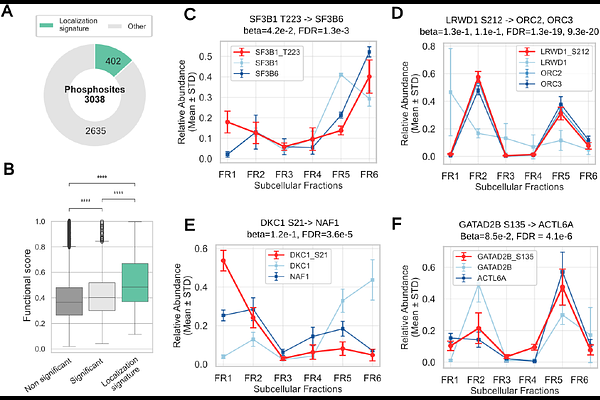
AbstractProtein phosphorylation regulates nearly every cellular process, yet most of the hundreds of thousands of human phosphosites remain functionally uncharacterized. Rather than prioritising phosphosites by conservation or structural features, here we use the abundance of an interaction partner as a readout of whether a phosphosite affects that interaction. This idea exploits the fact that subunits of stable complexes are often degraded when unbound. Here, we apply a nested linear regression model to pan-cancer data from 1,006 tumours, while controlling for transcriptional and other covariates. We identified 6,160 associations between 3,038 phosphosites and the abundance of interacting proteins, including several known interaction-regulating sites. Mapping these onto AlphaFold-predicted complexes placed 239 sites at interaction interfaces, while another 402 were linked to compartment-specific localisation, indicating that phosphorylation can also tune interactions by relocating proteins between compartments. Affinity-purification mass spectrometry of NKAP and NUF2 phosphosite mutants experimentally supported some of these predictions. Together, this framework reveals a widespread coupling between phosphorylation and interaction-dependent protein abundance and provides a prioritized, structure-informed resource for characterizing the human phosphoproteome.