Circulating Immune Profiling Reveals Immune Signatures Associated with Disease Stage and Outcome in Endometrial Cancer

Circulating Immune Profiling Reveals Immune Signatures Associated with Disease Stage and Outcome in Endometrial Cancer
Pineiro-Perez, R.; Vilar, A.; Arias, E.; Sampayo, V.; Abalo-Pineiro, A.; Rodriguez, C.; Cortegoso, A.; Marquez, R.; Diaz, E.; Moreno-Bueno, G.; Palacio, I.; Blanco-Prieto, S.; Vazquez-Tunas, L.; Fernandez-Perez, I.; Munera-Maravilla, E.; Calabuig, S.; Caballero, C.; Herrero, A.; Lopez-Lopez, R.; Cueva, J.; Vinuela-Roldan, J. E.; Muinelo-Romay, L.
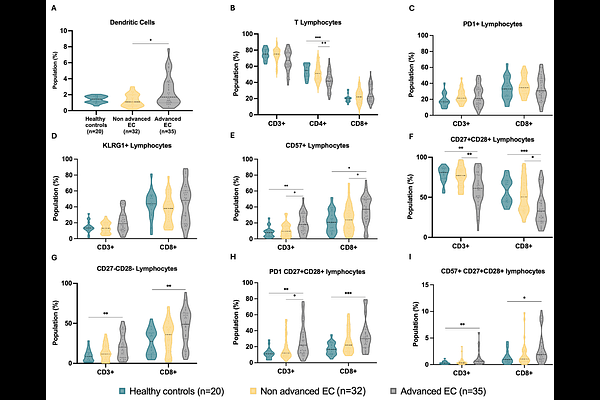
AbstractAlthough the tumor immune microenvironment has been studied in endometrial cancer, the systemic immune alterations associated with disease progression and their potential prognostic significance remain poorly defined. In this study, peripheral blood immune subsets were characterized by multiparametric flow cytometry in 67 patients with EC and 20 healthy controls, including dendritic cells, MDSCs, T-cell subsets, NK cells, and exhaustion and senescence associated markers. Immune profiles were similar between healthy controls and patients with early-stage disease, whereas advanced tumors showed marked changes, including dendritic cell expansion, reduced CD4+ T-cell proportions, and increased frequencies of CD8+CD27-CD28- and CD8+CD57+ populations. Among clinicopathologic features, MDSC levels were associated with tumor grade and myometrial infiltration, while regulatory T cells were increased in TP53-mutated and microsatellite-stable tumors. In the advanced cohort (n=31), non-responders frequently displayed elevated CD8+, CD8+CD27-CD28-, and CD8+CD57+ levels alongside decreased CD27+CD28+ proportions. In multivariable Cox models, higher baseline CD8+ (HR 1.13), CD8+ CD27-CD28- (HR 1.04), and CD8+CD57+ proportions (HR 1.07; all p<0.05) were independently associated with shorter PFS, whereas higher CD27+CD28+ levels were associated with improved PFS. CD27-CD28- proportions were also linked to worse PFS by Kaplan-Meier analysis (HR 5.1, log-rank p=0.005). Longitudinal analysis (n=28) showed that senescent-like lymphocyte levels remained associated with progression across timepoints (OR 18.80), whereas total CD8+ proportions diverged progressively, reaching significance only from 6 months onward. Together, these findings identify systemic immune remodeling as a characteristic of advanced endometrial cancer and support the potential of circulating immune profiling for patient stratification and prognostic assessment, pending validation in larger prospective cohorts.