Recoil-regulated extreme mass-ratio inspirals in AGN disks

Recoil-regulated extreme mass-ratio inspirals in AGN disks
LingQin Xue, Zoltán Haiman, Hiromichi Tagawa, Imre Bartos
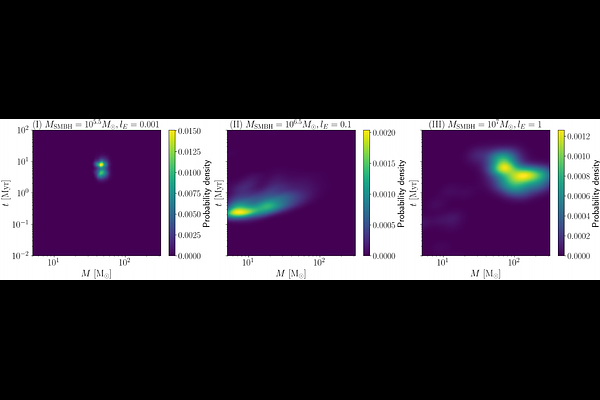
AbstractExtreme mass-ratio inspirals (EMRIs) are among the primary targets of future space-based gravitational-wave observatories, such as LISA, TianQin, and Taiji. Active galactic nucleus (AGN) disks provide a gas-rich environment in which stellar-mass black holes can migrate toward central supermassive black holes and form EMRIs. Previous studies of this ``wet'' channel have largely neglected stellar interactions within the disk. Here we show that binary formation, hierarchical mergers, and recoil kicks fundamentally regulate wet EMRI formation in AGN disks. Using semi-analytical AGN disk models combined with Monte Carlo simulations across supermassive black hole masses of $10^5$--$10^7M_\odot$ and Eddington ratios of $10^{-3}$-1, we find that recoil kicks from mergers and binary--single interactions repeatedly lift stellar-mass black holes out of the disk plane, temporarily interrupting migration and strongly suppressing EMRI formation in much of parameter space. Detectable EMRIs are therefore preferentially produced in young AGNs, typically within $\sim$ 10-20Myr of disk formation, and often involve merger-grown secondary black holes. We predict LISA detection rates of $\sim$ 1-30yr$^{-1}$, with the observable population dominated by low-mass AGNs and sensitive to the poorly constrained demographics of faint active nuclei. Our results identify stellar interactions as a key ingredient in the evolution of compact objects in AGN disks and show that future EMRI observations can probe both AGN disk physics and the low-mass AGN population.