Interplay Between Cholesterol Concentration and Membrane Curvature in Liposomes Revealed by Molecular Dynamics Simulations

Interplay Between Cholesterol Concentration and Membrane Curvature in Liposomes Revealed by Molecular Dynamics Simulations
Khodadadi, E.; Derakhshani-Molayousefi, M.; Khodadadi, E.; Moradi, M.
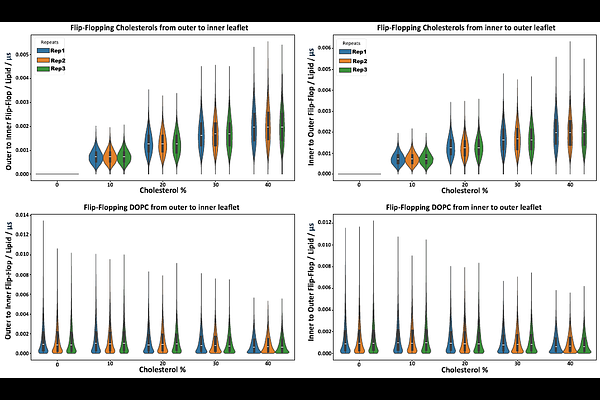
AbstractLiposomes are widely used as model membranes and nanoscale drug delivery systems, where cholesterol plays a key role in regulating bilayer structure and dynamics. However, how cholesterol concentration influences the structure and dynamics of liposome and how this influence is dependent on membrane curvature are not fully understood at the molecular level. In this work, coarse-grained molecular dynamics simulations using the MARTINI force field were employed to examine the concentration-dependent behavior of cholesterol in planar and curved membranes composed of cholesterol and unsaturated phospholipids, namely DOPC. More specifically, a planar lipid bilayer and an approximately 50-nm liposome were simulated to represent two extreme limits of small and large curvature, respectively. Increasing cholesterol concentration led to thicker membranes and reduced solvent exposure, consistent with cholesterol's condensing effect. Membrane curvature enhanced interleaflet coupling and increased tail interdigitation relative to planar systems. Notably, DOPC flip-flop rate in spherical bilayers exhibited a non-monotonic dependence on cholesterol content, reflecting a balance between curvature-induced packing stress and cholesterol-driven ordering. These findings provide molecular-level insight into how cholesterol and curvature together shape the structure and dynamics of unsaturated lipid bilayers.