Opposing regulatory logics converge on ABA receptors to govern the trade-off between growth and drought acclimation

Opposing regulatory logics converge on ABA receptors to govern the trade-off between growth and drought acclimation
Wu, C.; Gu, S.; Liu, X.; Zhang, Y.; Zhang, L.; Liu, Q.; Lu, J.; Huang, J.; Yang, G.; Yan, K.; Zheng, C.; Zhang, S.
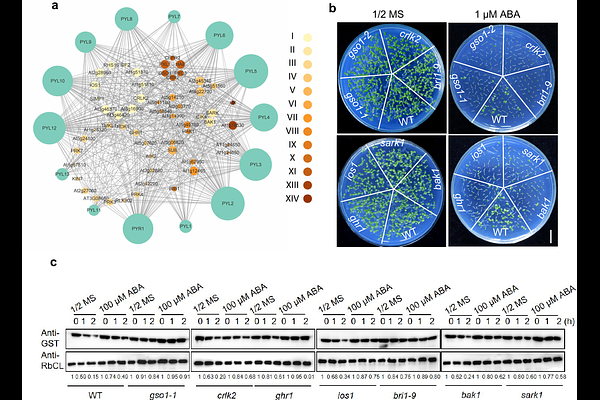
AbstractPlants must dynamically balance growth with stress responses, a trade-off centrally governed by the hormone abscisic acid (ABA). How ABA sensitivity is nimbly tuned to meet this challenge remains a fundamental question. Here, we uncover a complex regulatory network of leucine-rich repeat receptor-like kinases (LRR-RLKs) that directly controls ABA receptors stability. We identify GASSHO1 (GSO1) as a core component that phosphorylates the ABA receptors PYL2 and PYL4, marking them for degradation and thus serving as a critical brake on ABA signaling. This brake operates under normal conditions but is released upon drought stress, when accumulated ABA suppresses the expression of GSO1-activating CIF peptides, increasing PYLs and sensitivity. Strikingly, this derepression mechanism opposes our previously identified CEPR2 pathway, where drought-induced CEP peptides inhibit the kinase stabilizing PYLs. The integration of these two antagonistic regulatory modules within a single LRR-RLK network reveals a sophisticated systems-level logic that allows for the precise and dynamic control of ABA perception. This work uncovers a molecular framework that explains how plants finely calibrate the critical balance between growth and drought acclimation.