A Genetic Atlas of Direct and Inverse Neuropsychiatric-Cancer Comorbidity

A Genetic Atlas of Direct and Inverse Neuropsychiatric-Cancer Comorbidity
Flores-Rodero, M.; Fores-Martos, J.; Sanchez-Orti, J. V.; Martinez-Perez, S.; Winkler, F.; Valencia, A.; Tabares-Seisdedos, R.; Sanchez-Valle, J.
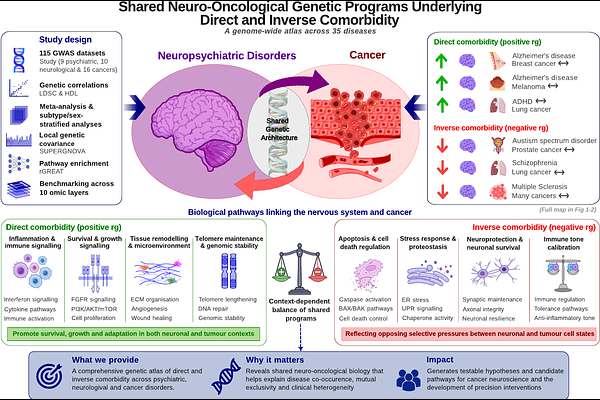
AbstractDirect and inverse comorbidities between neuropsychiatric disorders and cancer are increasingly recognised as important features of the nervous system-cancer relationship, yet the inherited genetic architecture underlying these patterns remains poorly understood. Here, we analysed pairwise genetic correlations across 35 diseases represented by 115 GWAS datasets, including 9 psychiatric disorders, 10 neurological diseases and 16 cancers, using linkage disequilibrium score regression (LDSC) and high-definition likelihood (HDL), complemented by meta-analysis, subtype-resolved analyses, local covariance mapping and multi-omic benchmarking. Genetic correlations were predominantly positive and strongest within disease categories, whereas cancer-neurological pairs showed the weakest overall genetic affinity. Meta-analysis and subtype resolution uncovered associations obscured in aggregate analyses, including opposing correlations between familial and late-onset Alzheimer's disease and lung cancer, revealing subtype-dependent neuro-oncological biology. Local analyses identified recurrent genomic loci where direct comorbidities are consistent with shared inflammatory, interferon, survival and tissue-remodelling programs, whereas inverse comorbidities suggest competing demands on apoptotic regulation, immune tone and stress-response calibration between neuronal and tumour-cell states. Together, these findings provide a genome-scale genetic framework for neuropsychiatric-cancer comorbidity and identify shared inherited biological programs as candidates for mechanistic investigation and therapeutic translation.