qg: Configuration-Driven, Multi-Vendor Acquisition Queue Generation with Reproducible Run-Order and QC Control for Mass Spectrometry

qg: Configuration-Driven, Multi-Vendor Acquisition Queue Generation with Reproducible Run-Order and QC Control for Mass Spectrometry
Wolski, W. E.; Schwarz, L.; Trachsel, C.; Zanella, M.; Riedi, C.; Schlapbach, R.; Othman, A.; Tuerker, C.; Nanni, P.; Panse, C.
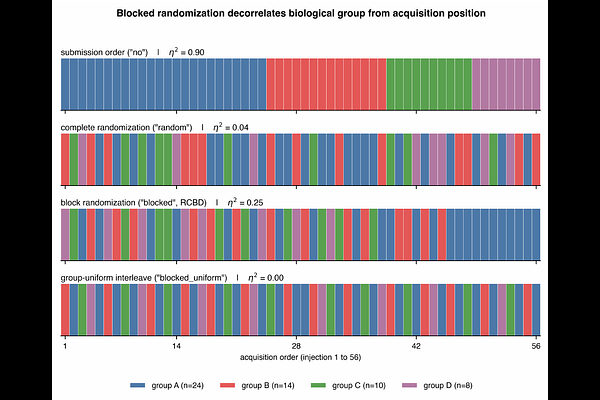
AbstractMass spectrometry laboratories must turn lists of submitted samples into acquisition queues. The run order and the placement of quality-control (QC) injections determine whether a design controls batch effects and signal drift, and whether those effects stay correctable afterward. Yet operators usually set them by hand in vendor worklist editors that neither randomize run order nor offer configurable, pattern-driven QC. We present *qg*, an open-source tool that builds acquisition queues with systematic run-order handling: four run-order modes (none, simple, blocked/randomized-complete-block, and group-uniform blocked), pattern-driven QC and standard injections, and sampler- and plate-aware positioning. Unlike plate-design tools that stop at a generic sample sheet, *qg* writes the native vendor acquisition file directly, for three instrument ecosystems (Thermo Fisher XCalibur, Axel Semrau Chronos, Bruker HyStar) across proteomics, metabolomics, and lipidomics. It separates a small, stateless generation pipeline from a declarative configuration layer, so a laboratory adapts instruments, QC patterns, layouts, and naming by editing version-controlled configuration through a validating editor rather than changing code. *qg* runs from a reactive web interface or a scripted command-line interface, integrated with a LIMS (B-Fabric) or standalone from uploaded tables; randomized runs record their seed and reproduce from exported parameters. On an unbalanced design, group-uniform blocked randomization spreads biological groups evenly across acquisition time, whereas textbook block randomization leaves a tail of the largest group and can track acquisition time worse than a plain shuffle. *qg* is released under the Apache-2.0 license.