Drosophila male genitalia rotation depends on permissive remodeling of the posterior abdomen

Drosophila male genitalia rotation depends on permissive remodeling of the posterior abdomen
Prieto, N.; Foronda, D.; Martin, P.; Simon, E.; Bischoff, M.; Noselli, S.; Sanchez-Herrero, E.
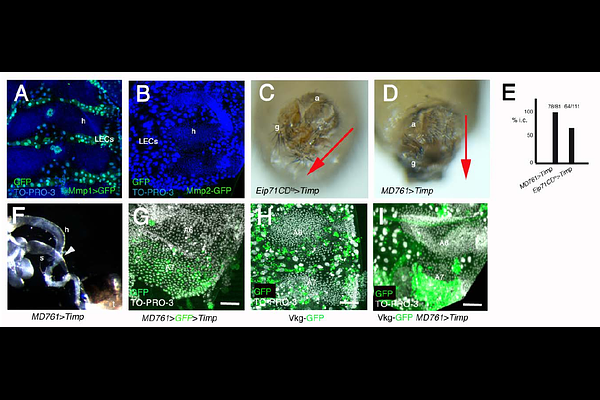
AbstractOne of the most characteristic morphogenetic processes in Drosophila is the 360{degrees} rotation of the male pupal genital disc. This movement is driven by the myosin Myo1D, whose expression in the genital disc is controlled by the Hox gene Abdominal-B. The rotation takes place in contact and relative to the posterior abdomen, yet the contribution of abdominal tissues has remained unclear. Here we show that normal genital disc circumrotation requires active remodeling of posterior abdominal larval epidermal cells that contact the rotating terminalia. Preventing apoptosis in these cells, or increasing EGFR signaling, delays their extrusion and results in incomplete rotation without altering rotational chirality. In parallel, elimination of Extracellular Matrix by Metalloproteinase 1 in these cells, although without leading to their extrusion, is also strictly required for genital disc circumrotation. Inhibition of this metalloproteinase activity leads to persistence of collagen IV and incomplete rotation, revealing an independent requirement for Extracellular Matrix clearance at the disc-abdomen interface. By contrast, genetic conditions that prevent formation or elimination of the male A7 segment do not necessarily impair genital disc rotation, demonstrating that A7 suppression and circumrotation are separable processes. These findings identify posterior abdominal tissue remodeling as an essential extrinsic requirement that enables genital disc circumrotation.