Simulating the jittering-jets explosion mechanism: circum-jet rings account for observed core-collapse supernova remnant morphologies

Simulating the jittering-jets explosion mechanism: circum-jet rings account for observed core-collapse supernova remnant morphologies
Muhammad Akashi, Noam Soker
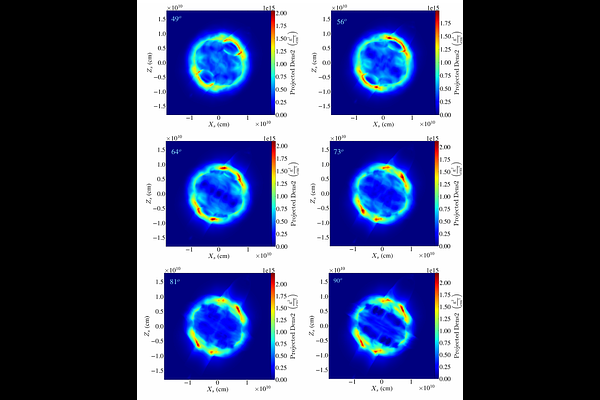
AbstractWe conduct three-dimensional hydrodynamical simulations of core-collapse supernova (CCSN) explosion driven by jets in the framework of the jittering jets explosion mechanism (JJEM), and obtain a pair of opposite circum-jet rings similar to those observed in some CCSN remnants (CCSNRs). We launch two pairs of jets along the same axis, the first of two opposite wide jets, and the second of narrow jets. The wide jets compress the core of a stripped-envelope stellar model to form a dense, fast-expanding shell. The narrow jets catch up with the dense shell, penetrate it, and compress the gas to the sides, forming the two opposite rings. At high inclination angles of the jets' axis to the line of sight, the projection of each ring on the plane of the sky forms two bright zones, where the rings cross the plane of the sky. This morphology explains that of SNR G46.8-0.3. At intermediate inclination angles, the rings are fully visible as two opposite bright elliptical rims. Our simulations explain the two prominent rings on the outer shell of CCSNR G11.2-0.3. Our results strengthen the claim that the JJEM is the primary explosion mechanism of CCSNe.