Multivalent Tau-Fyn interactions cooperatively arrest postsynaptic density condensate dynamics

Multivalent Tau-Fyn interactions cooperatively arrest postsynaptic density condensate dynamics
Shen, Z.; Bremer, A.; Sun, D.; Cima-Omori, M.-S.; Honigmann, A.; Becker, S.; Zweckstetter, M.
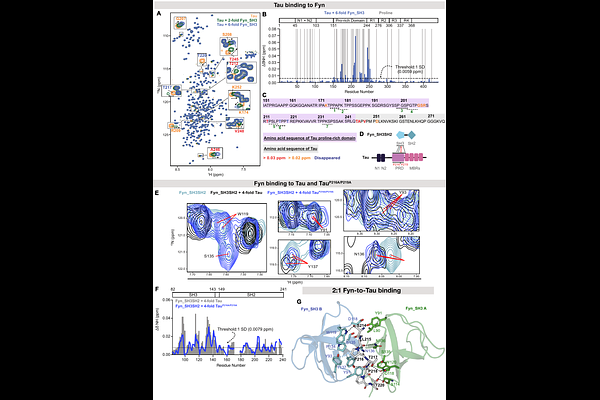
AbstractTau-Fyn signaling at postsynaptic sites is implicated in synaptic dysfunction and neuronal hyperexcitability in Alzheimer's disease and related tauopathies, yet the molecular mechanisms by which Tau-Fyn interactions influence postsynaptic signaling assemblies remain poorly understood. Here, we reconstitute biomolecular condensates and membrane-associated assemblies that mimic the postsynaptic density (PSD) to investigate how Tau and Fyn regulate PSD organization and dynamics. We show that Tau and Fyn co-partition into PSD condensates and N-methyl D-aspartate receptor subtype 2B (NR2B)-associated PSD clusters, with both proteins preferentially enriching in the condensed phase relative to core PSD scaffold proteins. Enrichment of Fyn within PSD condensates is recapitulated by an SH3-SH2 fragment lacking the kinase domain, indicating that the kinase domain is dispensable for condensate partitioning. Fluorescence recovery after photobleaching reveals that Tau markedly reduces Fyn mobility and, together with Fyn, cooperatively drives a pronounced dynamic arrest of PSD condensate components, including the central scaffold protein PSD-95. Disruption of a major Tau-Fyn interaction hotspot by P216A/P219A mutations in Tau nearly completely restores the mobility of both Fyn and PSD-95, demonstrating that cooperative Tau-Fyn interactions are required for dynamic arrest. NMR spectroscopy identifies a multivalent interaction network between the Tau proline-rich region and the Fyn SH3 domain involving multiple binding motifs, with residues P216 and P219 acting as major interaction determinants. A 1.4 [A] crystal structure of the Fyn SH3 domain bound to a Tau peptide reveals a ternary 2:1 Fyn:Tau assembly, providing structural support for multivalent Tau-Fyn engagement. Together, our findings establish a condensate-based mechanism by which multivalent Tau-Fyn interactions cooperatively regulate PSD condensate dynamics and provide a molecular framework linking Tau-Fyn signaling to synaptic dysfunction in tauopathies.