Supermassive Black Hole Winds in X-rays: SUBWAYS V. Properties of hot coronae in quasars at intermediate redshift

Supermassive Black Hole Winds in X-rays: SUBWAYS V. Properties of hot coronae in quasars at intermediate redshift
S. Peluso, G. Lanzuisi, A. Comastri, M. Brusa, M. Giustini, G. Miniutti, S. Bianchi, V. E. Gianolli, R. Middei, P-O. Petrucci, L. Borrelli, E. Amenta, E. Bertola, B. De Marco, A. De Rosa, S. Kraemer, G. Kriss, Y. Krongold, S. Mathur, A. Merloni, E. Nardini, F. Panessa, E. Piconcelli, G. Ponti, F. Ricci, A. Tortosa, L. Zappacosta, R. Serafinelli
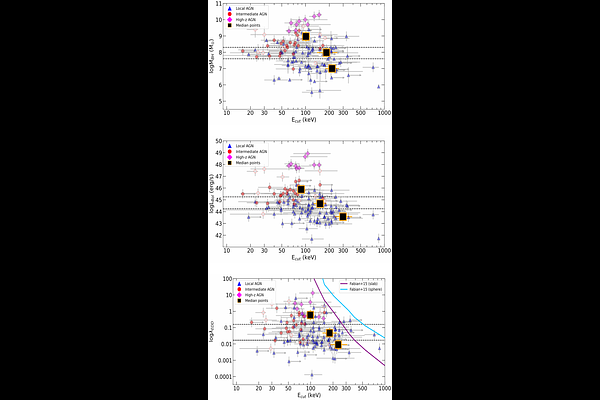
AbstractWe present the X-ray analysis of coronal properties in a statistically representative sample of 23 mostly radio-quiet AGN from the SUBWAYS campaign (SUpermassive Black holes Winds in XrAYs), focusing on quasars at redshifts $0.1 < z < 0.4 $ and bolometric luminosities $2 \times 10^{44} <L_{bol}(erg/s) < 2 \times 10^{46}$. The main aim of this work is to investigate the properties of the hot corona through the study of the hard X-ray band emission, including a proper treatment of the soft X-ray band. High-quality X-ray spectra from XMM-Newton, complemented by NuSTAR data extending up to 30-40 keV in the rest frame, are available for this sample. The soft X-ray band (0.3-2 keV) spectrum is best fitted by a warm corona model with a median temperature of 0.40 keV, and an optical depth in the range $τ$=20 - 40, consistent with previous results on lower luminosity sources. The hard X-ray band is well described using a hot corona model, with a median high-energy cut-off of 87 keV, at the lower end of the distribution of typical values found in Seyfert galaxies (100 - 200 keV). The derived median value of the optical depth ($τ$ = 1 - 5) suggests the presence of a moderately optically thick corona. Combining the SUBWAYS results with literature samples at low and high redshift, we assemble the largest sample to date of AGN with E$_{cut}$ and accretion parameter measurements, finding a significant anticorrelation of E$_{cut}$ with both $λ_{Edd}$ and $L_{bol}$ with the median E$_{cut}$ decreasing from 250 - 300 keV at low accretion rates and luminosities to 90 - 100 keV at high accretion rates and luminosities - consistent with enhanced coronal cooling, possibly driven by pair-production. These results favor cooler, optically thicker coronae in luminous AGN compared to those in lower-luminosity Seyfert galaxies.