AOPGraphExplorer 2.0: An Interactive Graph-Based Platform for Multi-Domain Mechanistic Annotation and Exploration of Adverse Outcome Pathways

AOPGraphExplorer 2.0: An Interactive Graph-Based Platform for Multi-Domain Mechanistic Annotation and Exploration of Adverse Outcome Pathways
Abdelwahab, A. A.; Hardy, B.
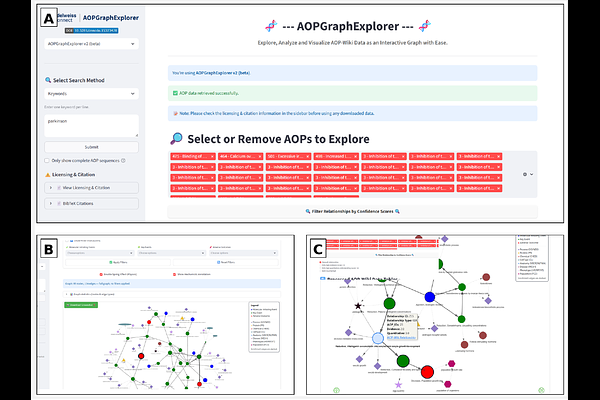
AbstractThe Adverse Outcome Pathway (AOP) framework is a cornerstone of modern mechanistic toxicology, providing a structured representation of causal biological events linking molecular initiating events to adverse health outcomes. However, the practical exploration and interpretation of AOPs remain challenging due to the fragmentation of mechanistic knowledge across heterogeneous biological databases and the limited availability of integrated, interactive tools. Here, we present AOPGraphExplorer 2.0, an interactive graph-based platform for the visualization, annotation, and analysis of AOP networks derived from AOP-Wiki. This new version introduces a scalable, modular architecture that integrates multi-domain mechanistic annotations, including biological processes, molecular entities, anatomical context, diseases, and stressors, directly into AOP graphs. AOPGraphExplorer 2.0 enables dynamic filtering of AOP networks based on weight-of-evidence and quantitative understanding scores, supports AOP-, Key Event-, and keyword-centric queries, and generates exportable interactive HTML and machine-readable JSON representations for documentation, sharing, and computational reuse. In addition, the platform provides automated network statistics and annotation coverage summaries, supporting transparent and reproducible analysis. By bridging AOP-Wiki with external biomedical knowledge resources in a unified graph framework, AOPGraphExplorer 2.0 transforms AOP exploration into a multi-domain systems-level analysis workflow. The platform supports hypothesis generation, mechanistic interpretation, and evidence-based decision-making in toxicology, pharmacology, and risk assessment. \