RiboCollSensor: a sensitive real-time detector of ribosome collisions in mammalian cells based on split-NanoLuc complementation

RiboCollSensor: a sensitive real-time detector of ribosome collisions in mammalian cells based on split-NanoLuc complementation
Alcalde, J.; Ventoso, I.
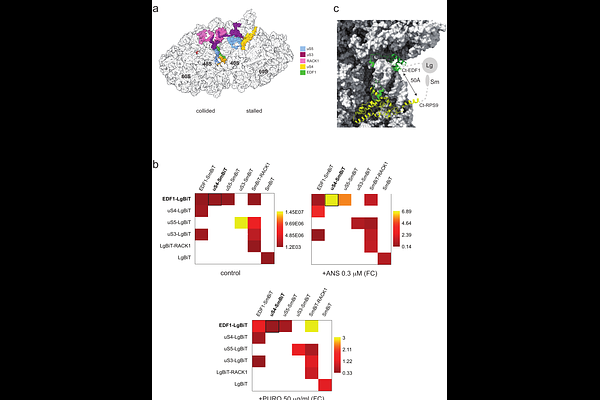
AbstractDisruption of ribosome flux on translating mRNAs can result in ribosome collisions that activate key cellular responses. Despite growing interest in the field, current methods to detect ribosome collisions have limited sensitivity and are not suitable for use in living cells. Here, we describe a novel, reliable, and highly sensitive method based on split-nanoluciferase complementation to detect ribosome collisions in living cells. RiboCollSensor relies on the specific recruitment of EDF1-LgBiT to collided ribosomes near uS4-SmBiT, which generates luminescence due to the proximity of the partners in the ribosome. This biosensor showed unprecedented sensitivity, allowing detection of basal ribosome collisions in unstressed cells or under very low stress levels, enabling real-time analysis of collision kinetics. Thus, an increase in collisions could be detected within the first minute after translation disturbance, confirming the role of ribosomal flux as a rapid sensor of cell stress. Ribosome collisions rapidly disappeared after stress withdrawal, whereas under persistent stress, recovery was slower, taking up to two hours depending on the cell type. The ease and flexibility of this method, which requires only transient co-expression of sensor partners in target cells, make it applicable across many cell types to monitor the impact of internal and external cues on ribosome dynamics in real time.