Selective miniprotein inhibitors of Aurora-A kinase designed using interaction-motif scaffolding

Selective miniprotein inhibitors of Aurora-A kinase designed using interaction-motif scaffolding
Miles, J. A.; Schiffrin, B.; Holder, J.; Wallis, E. J.; Manfield, I. W.; Burnap, S. A.; Struwe, W. B.; Gergely, F.; Bayliss, R.
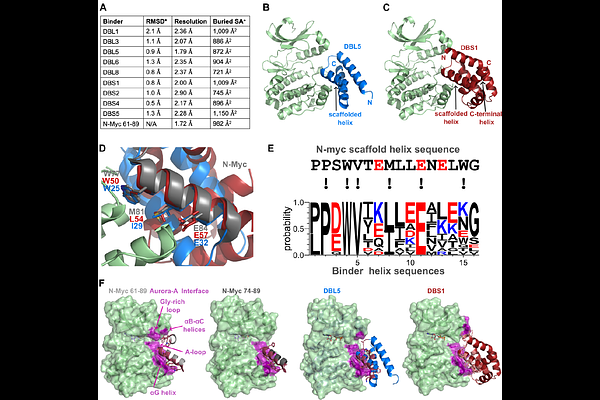
AbstractTargeting kinase ATP-binding sites has produced many successful therapeutics, but selectivity remains a major challenge. We hypothesised that substrate-recognition surfaces could provide an alternative route to selective kinase inhibition. Here, we designed and tested structure-guided miniprotein inhibitors of Aurora-A using N-Myc as a template, a natural weak binder of the P+1 pocket. The most potent designs bind Aurora-A with single-digit nanomolar affinity, more than a thousand fold higher than the starting template, and selectively inhibit Aurora-A over Aurora-B in kinase assays and mitotic cells. Despite diverse architectures, successful binders targeting the substrate-recognition surface converged on a common strategy, coupling extensive engagement of the G-helix with activation loop stabilisation. Together these results show that selective kinase inhibition can be achieved by exploiting structurally well-defined active-state conformations rather than kinase-specific inactive states. Our work establishes a framework for converting weak substrate-recognition surface interactors into potent, selective kinase inhibitors through structure-guided protein design.