Computational Design Strategies for Nanoscale 3D Auxetic Metastructures from DNA

Computational Design Strategies for Nanoscale 3D Auxetic Metastructures from DNA
Seo, S.; Madhvacharyula, A.; Swett, A.; Li, R.; Du, Y.; Choi, J. H.
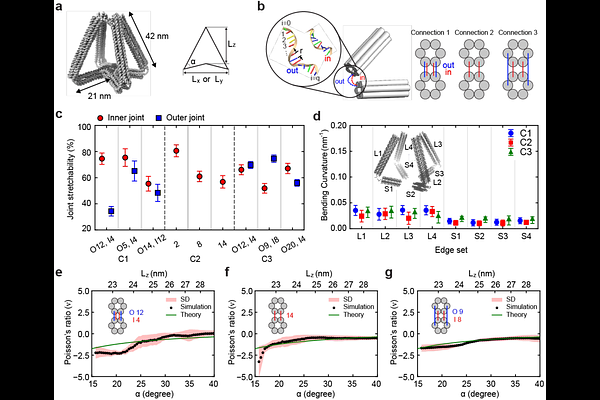
AbstractAuxetic metamaterials exhibit negative Poisson's ratio behaviors due to their architecture of periodically arranged unit cells. Although mechanical metamaterials are well established at the macroscale, programmable auxetic units remain scarce at the nanoscale. DNA origami offers a promising platform to bridge this gap, but design principles for dynamically deformable 3D auxetic nanostructures remain largely unexplored. Here, we develop design strategies for such 3D auxetic metastructures built from wireframe DNA origami. As a model system, we use a 3D re-entrant triangular unit composed of double-stranded DNA (dsDNA) bundle edges connected by single-stranded DNA (ssDNA) joints. Using coarse-grained molecular dynamics (MD) and umbrella-sampling free-energy simulations, we examine how edge design and joint-connection scheme govern auxetic responses and the energetics of the structural transformation. Our results show that auxetic performance and deformation energetics emerge from the coupled effects of DNA bundle rigidity and connector mechanics at the joints. This study provides mechanistic insights and design guidelines for programmable auxetic motion and energetics in 3D DNA origami metamaterials, advancing the development of stimuli-responsive nanomechanical devices.