Longitudinal dynamics of organ-specific proteomic aging clocks over a decade of midlife

Longitudinal dynamics of organ-specific proteomic aging clocks over a decade of midlife
Neirynck, R. E.; Chirinos, J. A.; Van Damme, M.; Coussement, L.; Segers, P.; De Buyzere, M.; Rietzschel, E. R.; De Meyer, T.
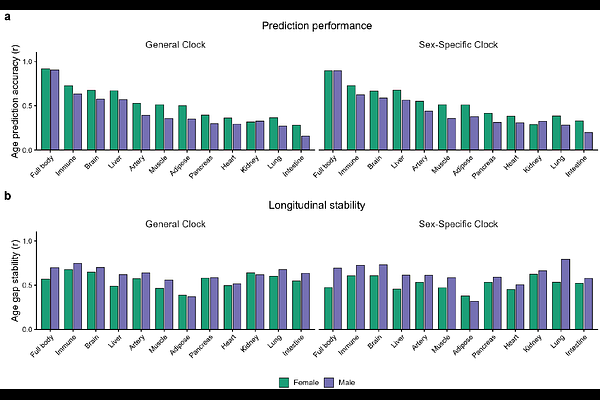
AbstractOrgan-specific proteomic clocks are promising tools for quantifying heterogeneity in biological aging, but their longitudinal behavior remains largely unexplored. Here, we analyzed paired plasma proteomic profiles with 10-year follow-up in middle-aged adults (n= 1,250) to evaluate their longitudinal properties. Cross-sectional associations of protein concentrations with age mirrored average longitudinal trajectories, validating the common cross-sectional training of clocks. Organ-specific age acceleration was moderately stable over the decade, and aging across organs progressed in parallel, with the immune and adipose systems acting as central hubs and early cardiorespiratory aging predicting downstream metabolic aging. Critically, longitudinal changes in predicted age tracked subclinical risk factor alterations. In women, the menopausal transition dominated the aging landscape and was associated with multi-organ age acceleration. Medication initiation altered clocks through specific drug-targeted proteins (such as renin and APOB) rather than generalized organ aging. Together, these findings position organ-specific proteomic clocks as interpretable, dynamic indicators of aging and organ health.