Conformational dynamics of exopolysaccharides underlie biofilm matrix mechanics in Vibrio cholerae

Conformational dynamics of exopolysaccharides underlie biofilm matrix mechanics in Vibrio cholerae
Nam, K.-M.; Fowler, N.; Kandel, R.; Zhu, Y.; Liu, Y.; Lai, Y.-J.; Hassan, M. F.; Gerace, E.; Asp, M.; Olson, R.; Li, Y.; Nieh, M.-P.; Zhong, M.; Woods, R. J.; Moreau, A.; Yan, J.
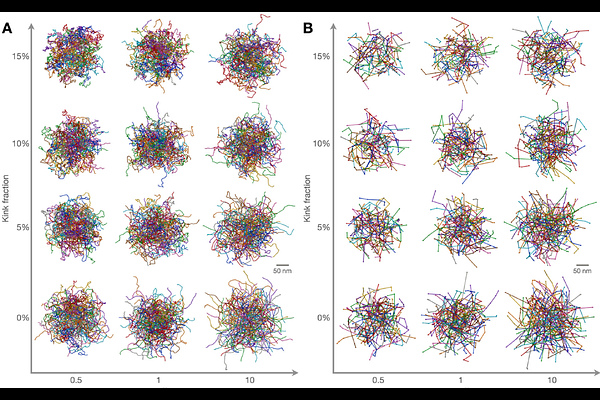
AbstractPolysaccharides remain the least understood biomacromolecules, particularly in terms of the relationship between their chemical structure and physical properties. On the other hand, polysaccharides often serve as the main structural components in biofilms: surface-attached aggregates of bacterial cells encased within a mechanically resilient extracellular matrix. The large chemical space explored by bacteria within biofilms provides excellent opportunities to establish the structure-function relationship for polysaccharides. In this paper, we systematically characterize various polymer properties of Vibrio polysaccharide (VPS), the major exopolysaccharide in biofilms formed by Vibrio cholerae, the causative agent of pandemic cholera. Using a combination of shear rheology, dynamic and static light scattering, and small-angle X-ray scattering, we measure the viscosity, molecular weight, persistence length, radius of gyration, and hydrodynamic radius of this chemically unique biopolymer. Combining all-atom and coarse-grained simulations, we show how the conformational flexibility of a single glycosidic linkage within each VPS monomer can lead to dramatic compaction of the entire polymer chain and nonclassical entanglement behavior. Our comprehensive quantification represents a rare endeavor for bacterial biofilms, whose matrix composition and physical properties remain largely nebulous; it also represents a significant step towards a detailed understanding of the molecular origins of biofilm mechanics.