L-2-hydroxyglutarate recycling is linked to coenzyme Q biosynthesis

L-2-hydroxyglutarate recycling is linked to coenzyme Q biosynthesis
Malatesta, M.; Gottinger, A.; Nicoll, C. R.; Herebian, D.; Mattiroli, D.; Cecchini, D.; Seibt, A.; Alfieri, A.; Distelmaier, F.; Mattevi, A.
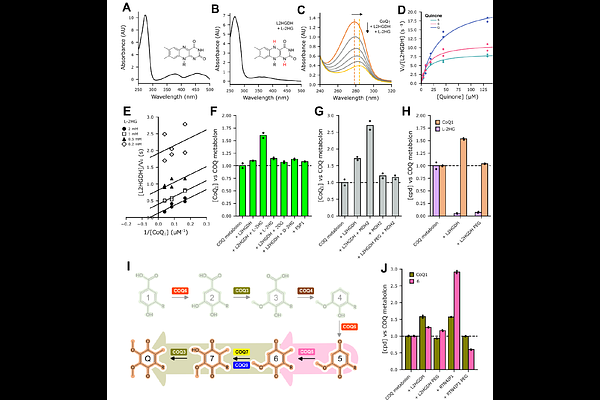
AbstractThe mitochondrial COQ metabolon catalyzes the late stages of the biosynthesis of coenzyme Q, an essential and ubiquitous cofactor. Here, by integrating coevolution, coexpression, colocalization and domain-fusion analyses, we identify L-2-hydroxyglutarate dehydrogenase (L2HGDH) as an integral component of this assembly. By acting in physical proximity to the COQ metabolon, L2HGDH sustains coenzyme Q production by maintaining the biosynthetic intermediates in their catalytically-active reduced state. Consistently, analysis of fibroblasts and urine samples from patients with primary coenzyme Q deficiency displayed marked accumulation of L-2-hydroxyglutarate. Cryo-electron microscopy reveals that L2HGDH forms a stable complex with COQ3 and COQ6, defining a heterotrimeric assembly that organizes catalytic sites on a shared membrane-facing surface thereby enabling localized quinone reduction. Together, these findings identify L2HGDH as a previously unrecognized component of the COQ metabolon, establish a direct link between central carbon metabolism and coenzyme Q biosynthesis, and expand the functional roles of metabolons in coordinating metabolic flux across distinct pathways.