RNAGAN: Train One and Get Four, Multipurpose Human RNA-Seq Analysis Tool with Enhanced Interpretability and Small Data Size Capability

RNAGAN: Train One and Get Four, Multipurpose Human RNA-Seq Analysis Tool with Enhanced Interpretability and Small Data Size Capability
HOU, Z.; Lee, V. H.-F.; Kwong, D. L.-W.; Guan, X.; Liu, Z.; Dai, W.
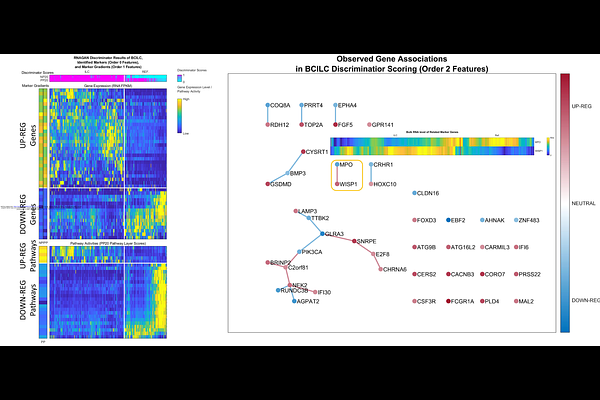
AbstractThe advent of artificial intelligence (AI) has brought revolutionary tools for biomedical transcriptomic (RNA-level) research. However, there are persistent constraints including limited interpretations with biomedical concepts such as functional pathways, small sample sizes and substantial time and computing power requirements for AI training. To overcome these limitations, we developed RNAGAN (https://github.com/ZhaozhengHou-HKU/RNAGAN-1.0.git), an AI tool with a generative adversarial network (GAN) structure with the objective of enhancing transcriptomic analysis. The network was established based on public human datasets comprising 4.6 million single cells from multiple organs and 5,900 sequenced samples of various cancer types with normal references. A specialized pathway neural layer was embedded to extract activities of predefined pathways from the Human Molecular Signatures Database (MSigDB), or newly learned pathways from single-cell data. The structure of RNAGAN (generator and discriminator) enables four applications after one shared training procedure: 1. single-cell and bulk-level patient stratification or differential diagnosis; 2. analysis of the gene and pathway markers in a selected disease; 3. pseudo data generation when sample size is limited for downstream analysis; 4. vectorization with gene and pathway-level features learned from multiple data sets. RNGAN contributes to the efficient utilization of limited data for transcriptomic studies.