Domain Insertion Improves the Precision of a CRISPR Adenine Base Editor

Domain Insertion Improves the Precision of a CRISPR Adenine Base Editor
Müller, M. M.; Southern, N. T.; Niopek, D.
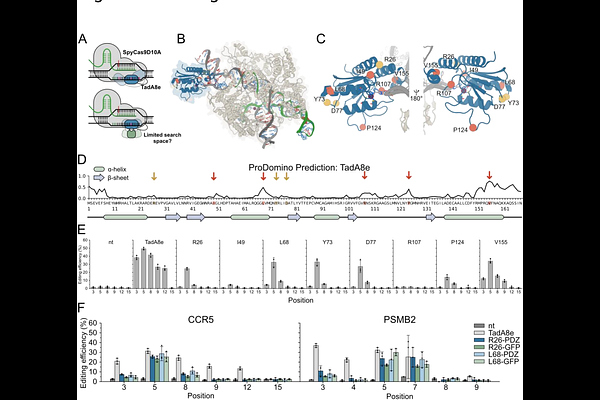
AbstractAdenine base editors (ABEs) enable efficient A*T to G*C conversion, but their broad activity windows frequently cause unintended bystander edits. We hypothesized that insertion of a bulky, inert protein domain into the base editor would limit the effective reach of the deaminase, thereby preferentially directing editing to the intended target adenine. Here, we systematically map domain insertion sites within the high-activity TadA8e adenine base editor using structure-guided design and computational inference. We find that TadA8e accepts domain insertions at multiple surface sites, with overall activity and editing window width dependent on insert position rather than domain identity. Excitingly, inserting domains at residue L68 preserved robust editing across multiple genomic loci while tightly focusing the editing window around position 5. Insertion of superfolder GFP at this site produced a base editor variant with a narrower editing window, the ability to track edited cells by fluorescence, and markedly reduced Cas-independent off-target editing. Our work highlights domain insertion engineering as a powerful strategy to create more focused and precise CRISPR base editors.