Cooperativity and Conformational Rearrangements in Protein-Protein and Protein-Ligand Interactions

Cooperativity and Conformational Rearrangements in Protein-Protein and Protein-Ligand Interactions
Thiyagaraj, D.; Del Re, A.; Pham, Q. D.; Gomez Garrote, I.; Saudi, A.; Fedorych, O.
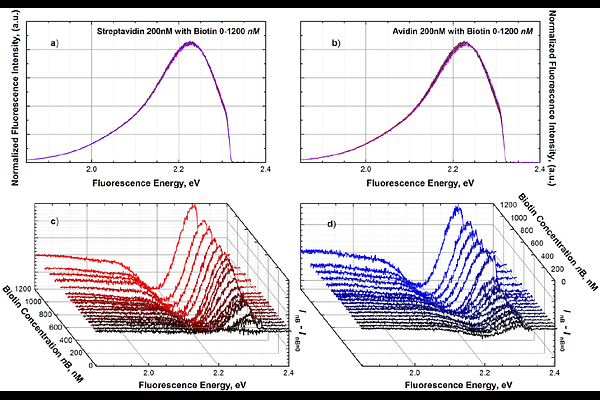
AbstractStreptavidin-biotin, avidin-biotin interactions are classical models for protein-ligand binding, yet the energetic changes accompanying biotin binding remain poorly resolved. Using fluorescent dyes as energy sensors, we show that biotin binding produces two distinct regimes occurring in parallel as concentration of biotin increases cooperativity and conformational rearrangements, wherein cooperativity is observed via exchange broadening of fluorescence linewidth and conformational rearrangements exclusively observed in emission energy. Where the first biotin binding creates the highest contribution to the emission energy. Further analysis of tetramer-tetramer only interactions revealed extremely long ranged intermolecular interactions extending to hundreds of nm. The intermolecular interactions become negligible only at concentrations of approximately 10 nM for both streptavidin and avidin. Affinity values estimated for these diluted samples were below 1 nM.