Circulating APOH promotes aortic dissection by activating the vascular smooth muscle cell NR5A1-PPARγ pathway.

Circulating APOH promotes aortic dissection by activating the vascular smooth muscle cell NR5A1-PPARγ pathway.
Ma, L.; Jin, L.; Liu, J.; Li, J.; Liu, M.; Chen, l.; Qiu, Z.
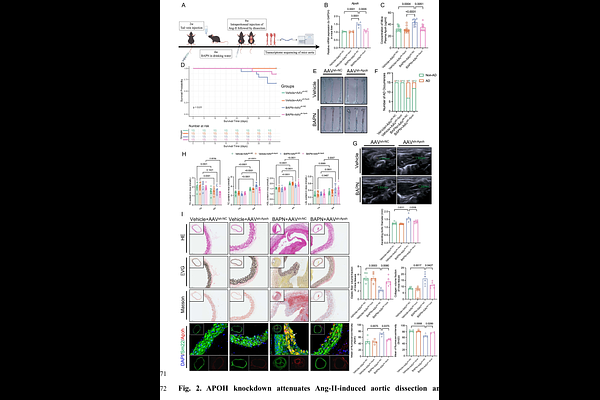
AbstractIntroductions: Aortic dissection (AD) is a life-threatening vascular disease with limited therapeutic targets. Apolipoprotein H (APOH), a circulating glycoprotein implicated in lipid metabolism, has not been studied in AD. Methods: Plasma APOH levels and aortic deposition were examined in AD patients. A {beta}-aminopropionitrile (BAPN) and angiotensin II (Ang-II)-induced mouse AD model with AAV-mediated Apoh knockdown was used to evaluate survival, aortic dilation, and extracellular matrix remodeling. Transcriptomic profiling, chromatin immunoprecipitation, and gene silencing in human aortic vascular smooth muscle cells (HAVSMC) were performed to dissect the mechanism. PPAR{gamma} agonist rescue was conducted in vivo. Results: APOH was elevated in plasma and deposited in AD aortas. Apoh knockdown improved survival, reduced AD incidence and ascending aortic dilation, and attenuated elastic fiber disruption and collagen deposition. Transcriptomics revealed enrichment of the PPAR pathway. APOH promoted HAVSMC phenotypic switching from a contractile to a synthetic state, decreasing ACTA2/TAGLN and increasing OPN/MMP9. Mechanistically, APOH upregulated NR5A1, which directly bound the PPAR{gamma} promoter to enhance PPAR{gamma} and FABP4 expression. Silencing NR5A1 or PPAR{gamma} reversed APOH-induced phenotypic switching and inflammation. In vivo, PPAR{gamma} agonist diminished the protective effects of Apoh silencing. Conclusion: APOH promotes AD progression through the NR5A1-PPAR{gamma} axis, driving vascular smooth muscle cell phenotypic switching and inflammation, and represents a potential therapeutic target.