Can a single supernova remnant account for the gamma-ray emission of G106.3+2.7?

Can a single supernova remnant account for the gamma-ray emission of G106.3+2.7?
P. Cristofari, G. Emery, T. Lubrano di Vavaria, H. Costantini, F. Cassol, M. -S. Carrasco, B. Le Nagat Neher
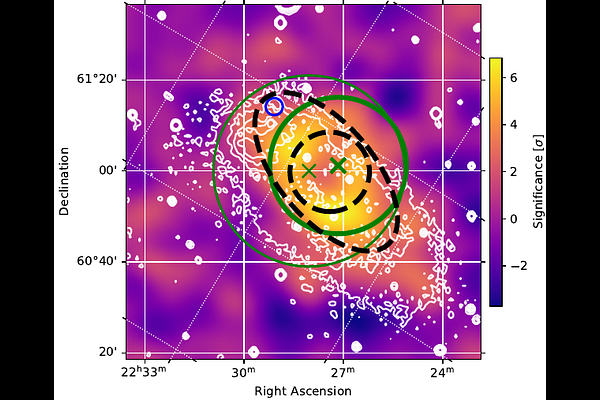
AbstractSNR G106.3+2.7 is a complex TeV emitting source whose emission is still poorly understood. It has especially been at the center of numerous discussions on its potential for being a supernova remnant (SNR) PeVatron, since its gamma-ray spectra seems not to exhibit any significant suppression in the multi--TeV range, up to $\sim 600$ TeV, thereby indicating the presence of $\sim$ PeV particles. We study the hypothesis in which a SNR evolving in a clumpy or cloudy environment is powering the TeV gamma-ray emission, detected mainly from two regions, the "head" and the "tail". We discuss the implications of such an hypothesis. We rely on a simple physically motivated analytical modeling of the shock dynamics and of the content of accelerated particles and confront it to available gamma-ray observations. We find that the current observed TeV gamma-ray emission in the head and tail regions can be accounted for by an active single SNR, with a natural hardening of the spectrum due to the expansion in a clumpy medium or escaping to a dense region in the tail. However, in all scenarios, the broadband gamma-ray emission from the GeV range to the $\gtrsim 100$ TeV range is difficult to reconcile with a standard SNR - whether originating from a thermonuclear or a core-collapse supernova - and instead points toward an association with the pulsar.