Glycosylation of anandamide and other bioactive N-acylethanolamines in mammalian cells and tissues

Glycosylation of anandamide and other bioactive N-acylethanolamines in mammalian cells and tissues
Stevens, A. F.; Peter, R. E. A.; Gagestein, B.; Ferraz, M.; Been, E.; Vleeshouwer, T.; Ttofi, I.; van den Berg, R. J. B. H. N.; van der Wel, T.; de Paus, L.; Deuschle, C.; van der Horst, C.; Heitman, L. H.; Artola, M. E.; Piomelli, D.; Grande, M. T.; Romero, J.; Overkleeft, H. S.; Brockmann, K.; Gasser, T.; Aerts, J. M. F. G.; van der Stelt, M.
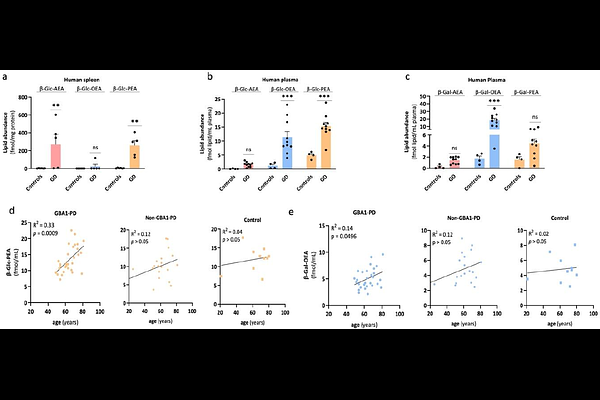
AbstractN-acylethanolamines (NAEs), including the endocannabinoid anandamide, are bioactive fatty acid amides that are normally hydrolyzed by fatty acid amide hydrolase (FAAH) or N-acyl acid amidohydrolase (NAAA). Strikingly, when canonical NAE degradation is blocked, NAE levels do not increase indefinitely but instead reach a plateau. This apparent metabolic ceiling suggests that additional, underexplored pathways contribute to NAE homeostasis. Identifying these pathways is essential to determine whether NAEs are converted into inactive metabolites or products with distinct biological properties. Here, we identify NAE glycosylation as a metabolic pathway that links endocannabinoid related lipid metabolism to glycosphingolipid turnover. We synthesized glycosylated NAEs and their isotope-encoded standards and developed targeted LC-MS/MS assays to monitor their enzymatic processing and quantify their abundance in mouse and human cells, tissues, and plasma. We show that non-lysosomal glucosylceramidase GBA2 transfers glucose or galactose to anandamide, N-oleoylethanolamine and N-palmitoylethanolamine, and lysosomal glucosylceramidase GCase hydrolyses {beta}-glycosylated NAEs ({beta}-Glyco-NAE) back to their parent NAEs. {beta}-Glyco-NAEs occur endogenously in macrophages and neuronal cells, increase when canonical NAE degradation is impaired, and accumulate in human samples with GCase deficiency, including Gaucher disease and GBA1-associated Parkinsons disease. {beta}-Glyco-NAEs do not engage the cannabinoid receptors, TRPV1, or PPAR, and potentiate inflammatory cytokine release, including IL6 and TNF, from microglia. Based on these findings, we pose that GBA2-dependent NAE glycosylation may constitute an overflow lipid-remodeling pathway that connects NAE metabolism to lysosomal dysfunction, inflammation and neurodegeneration.