Topological defects and coherent myocardial chirality shape torsional heart contraction

Topological defects and coherent myocardial chirality shape torsional heart contraction
Kawahira, N.; Yamamoto, T.; Washio, T.; Nakajima, Y.; Yashiro, K.; Xu, V.; Kawaguchi, K.; Nakano, A.
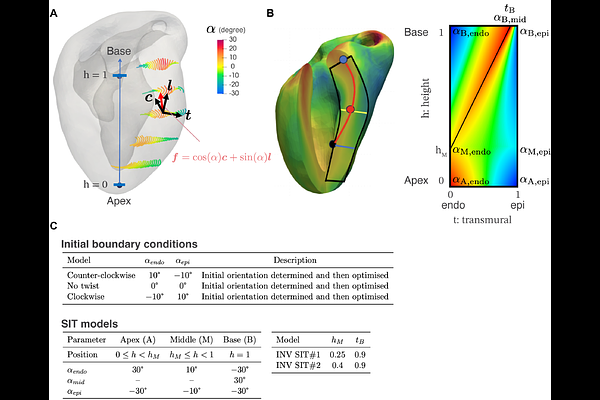
AbstractThe efficient pumping of the mammalian heart relies on torsional contractile motion generated by its highly ordered three-dimensional (3D) architecture of myocardial fibres. However, the topological principles governing how its complex geometry translates into contractile mechanics remain elusive. Here, we show that the mammalian heart forms a chiral nematic field, a biological analogue to 3D liquid crystals, whose topological organisation underlies its function. Analysis of 3D imaging data revealed disclination lines, continuous assemblies of topological defects characteristic of nematic systems, within the compact myocardium. Finite-element simulations reveal that these defects are not mere structural irregularities but can locally modulate contractile behaviour and reduce mechanical work. In heterotaxy hearts with reversed global anatomy (situs inversus), myocardial fibres retain a predominantly counter-clockwise twist, similar to that of the normal heart, but with a small clockwise component near the base. This decoupling of tissue-level chirality from systemic left-right patterning suggests that cardiac twist is an intrinsic property of the myocardial fibre. Mechanical simulations of situs inversus heart demonstrate that the coherence of transmural chirality, rather than its specific orientation, is critical for contractile efficiency. Together, these findings establish the heart as a topological material and reveal how organised chiral fields generate robust organ-level mechanical function.