Identification of Proliferation-Specific Dependencies for Therapeutic Targeting of Liver Cancer

Identification of Proliferation-Specific Dependencies for Therapeutic Targeting of Liver Cancer
Castoldi, M.
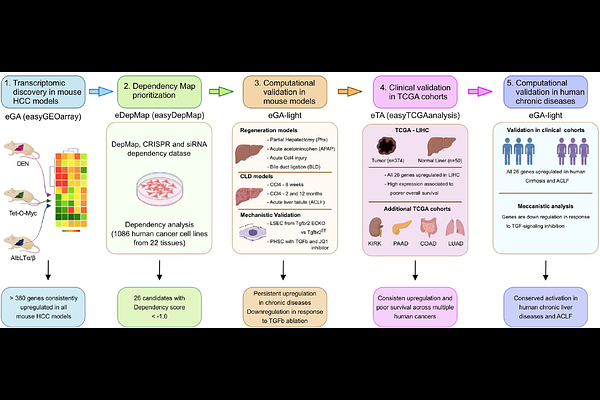
AbstractHepatocellular carcinoma (HCC) remains a leading cause of cancer-related mortality worldwide despite recent therapeutic advances, driven in part by its marked etiological and molecular heterogeneity and the lack of broadly effective therapeutic targets. Identifying conserved tumor dependencies shared across distinct etiological backgrounds may provide new opportunities for targeted therapy. Here, we developed an integrative computational framework to systematically integrate transcriptomic, functional genomics, and clinical datasets for the identification and prioritization of candidate tumor dependency genes in liver cancer. We reanalyzed transcriptomic data from murine models of liver cancer driven by genotoxic (DEN), oncogenic (c-Myc), and inflammatory (lymphotoxin) stimuli, identifying more than 380 genes consistently upregulated across all tumor models. Functional enrichment analysis revealed a strong overrepresentation of cell cycle-related pathways and liver cancer signatures. Integration with DepMap dependency datasets identified 26 genes with strong dependency scores. Candidate genes were further prioritized by comparing their expression across models of liver regeneration, chronic liver injury, and liver cancer. Analysis of the TCGA-LIHC cohort confirmed significant overexpression of all 26 genes in human HCC, with high expression associated with poor patient survival. Together, these findings establish an integrative framework for identifying conserved tumor dependencies, providing a prioritized set of proliferation-associated genes for functional evaluation as therapeutic targets in HCC.