A network-based deep learning model integrating subclonal architecture for therapy response prediction in cancer

A network-based deep learning model integrating subclonal architecture for therapy response prediction in cancer
Kim, S.; Ha, D.; Nam, A.-r.; Cheong, S.; Lee, J.; Kim, S.; Park, S.
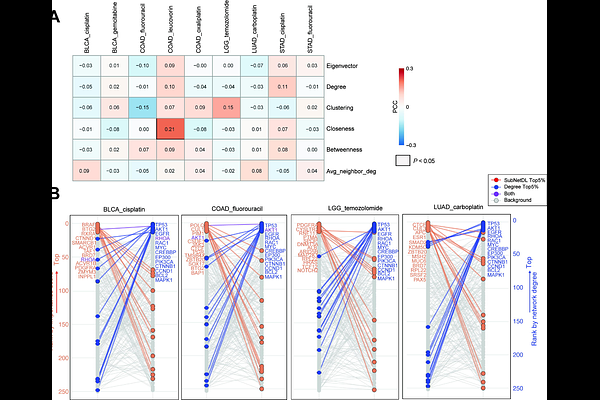
AbstractPredicting treatment response remains challenging in oncology, particularly given the growing diversity of therapeutic options. Despite efforts using gene expression signatures, or integrative multi-omics frameworks, robust and interpretable biomarkers remain limited. We present SubNetDL, a deep learning framework that integrates subclonal mutation profiles and protein-protein interaction networks via network propagation. Unlike condition-specific approaches, SubNetDL leverages somatic mutations alone and is applicable across diverse cancer types and treatment modalities. Applied to ten TCGA cancer-drug combinations, SubNetDL achieved consistently strong performance (median AUROC = 0.74) and successfully generalized to two independent immunotherapy datasets (median AUROC = 0.77). Importantly, it identified candidate biomarker genes with treatment-specific relevance. SubNetDL prioritized genes that were not central in the network, highlighting its ability to capture context-specific patterns beyond traditional metrics. In conclusion, our approach offers a robust and interpretable framework for identifying predictive biomarkers and stratifying patients based on mutation profiles and network context.