The Barcode Inference Pipeline (BIP): From Sequencer Output to DNA Barcodes

The Barcode Inference Pipeline (BIP): From Sequencer Output to DNA Barcodes
Prosser, S. W.; Thompson, K. A.; Bard, N. W.; Floyd, R. A.; Ozsahin, E.; Hebert, P. D. N.
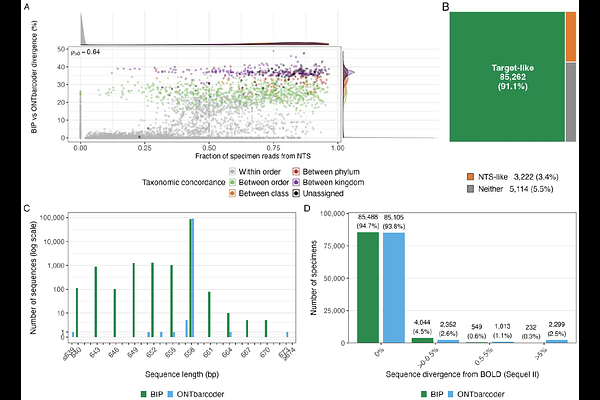
AbstractDNA barcoding involves the recovery of a DNA sequence for a target gene region from its source specimen. This process gains complexity when multiple sequences are recovered from a specimen, as is often the case when data are generated by high-throughput sequencers. This diversity can reflect both methodological artifacts (e.g., chimeras, PCR errors, sequencing errors, tag jumps) and real template diversity in the DNA extract (e.g., contamination, endosymbionts, NUMTs, parasites). To support analysis of the sequence data from three million specimens annually, the Centre for Biodiversity Genomics (CBG) has developed BIP, the Barcode Inference Pipeline. Compatible with all sequencing platforms, BIP processes .fastq files and returns both target DNA barcodes and non-target sequences. To generate results, BIP implements quality and size filtration, demultiplexing, primer trimming, chimera scanning, sequence error correction, OTU delineation, and sequence identification. When analysis targets the cytochrome c oxidase 1 (COI) barcode region, BIP also assigns each OTU to a known BIN or identifies its nearest neighbour BIN. As final output, BIP returns summary files ready for upload to BOLD or for other downstream analyses. They include a taxonomic assignment for each OTU, generated by comparison with a DNA barcode reference library. We describe BIP's flexibility and structure, then demonstrate its functionality by analyzing COI sequence data from 100K specimens. Because of its capacity to disentangle target and non-target sequences, BIP outperforms an alternative software package, ONTbarcoder, in several important ways. To ease access, installation, and functionality, BIP is provided as a Docker container (github.com/cbg-innov/BIP).