Neutrinos and gamma rays from Seyfert galaxies constrain the properties of coronal turbulence

Neutrinos and gamma rays from Seyfert galaxies constrain the properties of coronal turbulence
Federico Testagrossa, Damiano F. G. Fiorillo, Luca Comisso, Enrico Peretti, Maria Petropoulou, Lorenzo Sironi
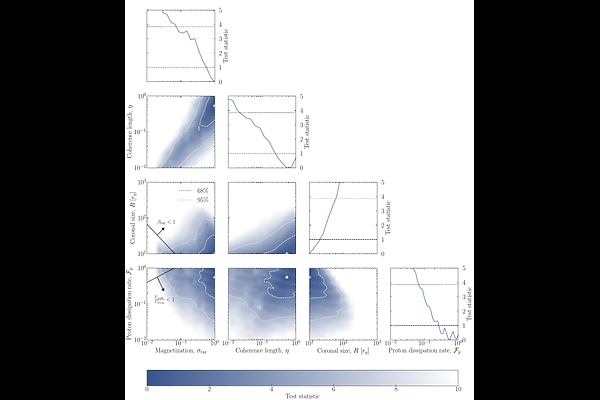
AbstractThe TeV neutrino signal observed by IceCube from the active galactic nucleus (AGN) NGC 1068 can probe its innermost coronal regions. If these neutrinos originate from hadrons accelerated within a magnetized turbulent corona, their intensity and spectrum depend on the turbulent magnetic field strength and turbulence coherence scale. The gamma rays accompanying neutrino production are absorbed in this optically thick environment, in a way that depends sensitively on the size of the corona. By a joint fit of the IceCube and Fermi-LAT observations, we translate the multimessenger signal from NGC 1068 and the tentative signal from NGC 7469 into quantitative constraints on coronal properties. NGC 1068, with a significant TeV neutrino excess, favors a compact, strongly magnetized corona with a large turbulence coherence length relative to the coronal size. NGC 7469, with two $\sim 100$ TeV neutrino events, points instead to a somewhat larger corona with much smaller coherence length and high magnetization, but a very small fraction of energy in non-thermal protons. We obtain the diffuse flux from a population of Seyfert galaxies identical to either NGC 1068 or NGC 7469. Finally, we consider a third scenario, motivated by the spectral break observed in the diffuse neutrino flux at tens of TeV, with coronal properties intermediate between the two point-source-inspired models. To enable detailed comparisons with the IceCube and electromagnetic observations, we release our model predictions in a GitHub repository.