Structure-activity of outer membrane proteins in native bacterial membrane vesicles by solid-state NMR

Structure-activity of outer membrane proteins in native bacterial membrane vesicles by solid-state NMR
Gopinath, T.; Shin, K.; Bera, S.; Kraft, A.; Samimuthu, K.; Gadicherla, A.; Kent, J. E.; Wood, N. A.; Marassi, F. M.
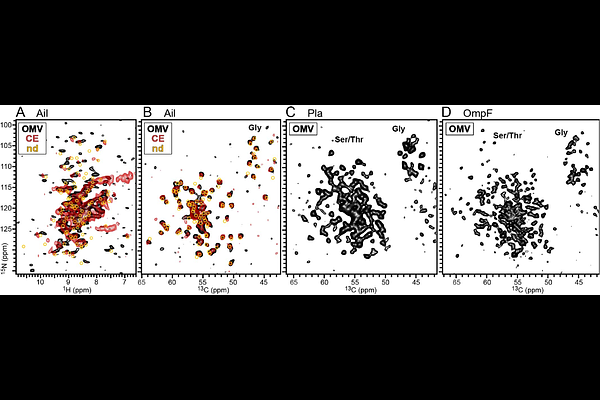
AbstractThe outer membranes (OMs) of bacterial pathogens are potent virulence factors and serve as the first line of defense against host immunity. Their striking bilayer asymmetry is essential for function but poses an exceptional challenge for reconstitution in vitro, limiting structure-activity analysis to artificial non-native platforms that can interfere with structure and function. Here, we describe bacterial OM vesicles (OMVs), natively secreted from the cellular OM during bacterial cell growth and development, as an effective vehicle for structure-activity analysis in situ based on solid-state nuclear magnetic resonance (NMR). We show that E. coli OMVs may be engineered to express a range of isotopically labeled target OM proteins, and isolated for solid-state NMR magic angle spinning (MAS) experiments. High resolution NMR spectra are obtained for three bacterial virulence factors: the adhesion invasion locus (Ail) and plasminogen activator protease (Pla) from Yersinia pestis, and the major porin (OmpF) from E. coli. The spectra reflect the native protein structures, report on the specific OMV membrane environment, and may be used to map protein interactions with their human host ligands, specifically the multifunctional glycoprotein Vitronectin (Vn) which binds Ail as part of its serum protection activity. Notably, OMVs support protein functionality, enabling structure and activity to be correlated in situ. OMVs expressing plasmid-encoded Ail recruit human Vn and confer serum protection to wild-type E. coli cells, while OMVs expressing plasmid-encoded Pla support the proteolytic activity of Pla. Taken together, the data establish OMVs as a robust new platform for structure-activity analysis of OM proteins in situ, offer new insights about the complexity of the bacterial OM, and reveal additional functional aspects of OMVs as key ancillary units of bacterial infection.