A mitochondrial program encodes brain vascular reserve

A mitochondrial program encodes brain vascular reserve
Xia, I. F.; Zhang, D.; Ercan-Sencicek, A. G.; Barak, T.; Hemalatha, A.; Gonzalez, D. G.; Hintzen, J.; Carneiro, P.; Baldissera, G.; Carlson, M.; Cheng, S.; Han, F.; Yang, X.-Z.; Feng, L.; Lake, N. J.; Greco, V.; Gunel, M.; Debette, S.; Zhu, Y.-C.; Nicoli, S.
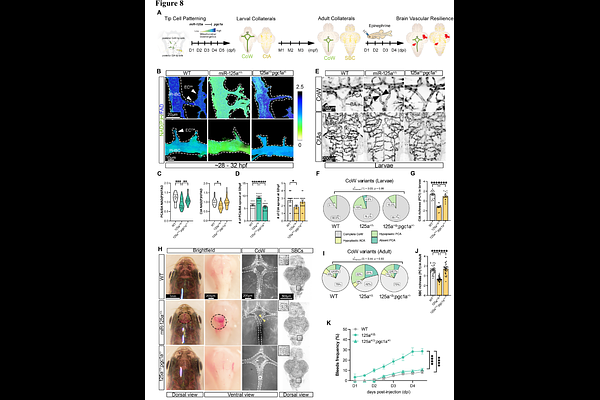
AbstractBrain resilience depends on collateral vessels whose geometries preserve blood flow when primary arteries are perturbed. How these protective vascular architectures are developmentally established remains unknown. Using longitudinal in vivo imaging in zebrafish, we show that mitochondrial state in embryonic angiogenic tip cells encodes the topology of basal and surface brain collateral networks. Mechanistically, microRNA-125a establishes the bioenergetic and redox balance of endothelial tip-cell mitochondria through conserved repression of the metabolic regulator PGC1a. Disruption of the microRNA-125a-PGC1a axis uncouples mitochondrial capacity from redox buffering in developing brain tip cells, redirecting their migration toward sparse, incompletely connected collateral network topologies and increasing adult cerebrovascular vulnerability. Consistent with this mechanism, humans with subclinical cerebrovascular injury exhibit reduced circulating microRNA-125a levels associated with incomplete basal collateral configurations. Together, these findings identify mitochondrial state as an instructive and conserved developmental program that encodes brain vascular reserve.